Showing posts with label The Winghorn Guard. Show all posts

Saturday, November 14, 2026

Aerth - The World of The Winghorn Guard

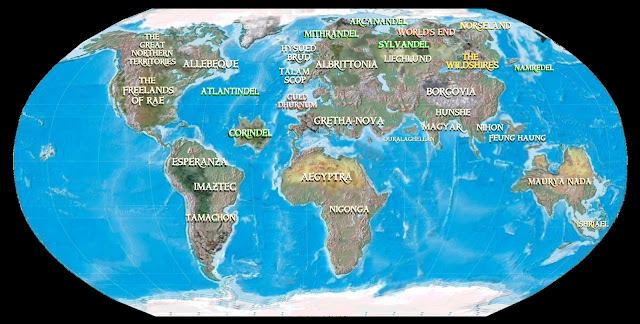
Aerth is the fictional world that serves as the focal point of nearly all of my Dungeons and Dragons-esque Medieval Fantasy RPG campaigns, especially those featuring The Order of The Winghorn Guard.


The World of Aerth and its moon, Luna


Aerth was first created in 1982 for a campaign originally titled 'PEGASUS' and later changed to The Winghorn Guard. The main idea behind the game was straightforward if a little unorthodox; run a Dungeons and Dragons campaign using the Gamemaster advice from a Superhero game.

Instead of using the Advanced D&D Dungeon Master's Guide to foster the development of a Fantasy game, I based my outline for the campaign on what I'd learned from years of reading comic books, particularly Marvel's Avengers and DC's Legion of Superheroes. Having purchased Villains and Vigilantes [2nd Edition], I used the Gamemaster advice in that that rulebook to set things in motion.

The catalyst for designing the world itself was a desire to integrate elements from the existing games my players were coming from into a single milieu. At the time, my Summer Camp friends wanted me to run an AD&D 1E game for them but they wanted to use the PCs they'd been playing in their School Year campaigns.

I said OK on the condition that the Aerth version of each character was, starting in our first session, a seperate and distinct entity from their School game variant. Essentially, they would play alternate versions of their established PCs who were identical up to the start of The Winghorn Guard campaign, at which time their histories diverage. Nothing from their School campaigns would effect their Aerth characters and nothing that happened in our game would effect their other adventures going forward.

The thing of it was, the games these PCs were coming from were very different from each other in terms of setting, style, and even tone. I had to incorporate real world mythology, Dungeons and Dragons lore, and original material into a single, unified cosmos.

And so, Aerth was born.


The Divisions of The Winghorn Guard and where they are on Aerth.
The Rangers and Nautica do not have a single, set location.


Aerth is an Alternate Earth and as such has many similarities to our real world's geography, weather, lifeforms, cultures, history, and especially folklore and mythology. The world does vastly differ from Earth in many ways however. As is plain to see on the maps, the continents and seas are not identical in shape or position. The world's axial tilt is slightly dissimilar, as is its distance from its sun, resulting in cooler overall temperatures and harsher winter months. 

Continents and Oceans


There are eight continents in total: Arcticus (roughly Antarctica), Bulan Ka (roughly Africa), Corindel (Australia), Gehennes (somewhat analogous to South Asia and the Middle East), Ledgorna (Europe and Asia), Loreia (North America), Pacifica (South America), and Polaria (a largely unexplored Greenland/Iceland/North Pole region). These aren't exactly one for one, though they give you a good idea of where many of the peoples and their myths can be found.

There are five oceans, commonly referred to as seas by Aerth's inhabitants, all of which can be quite dangerous for the unprepared. In addition, the lands are dotted with lakes and rivers of varying sizes, depths, and significance to the locals and sometimes beyond.

While a great deal of exploration has occurred over the centuries, much more of the world  remains undiscovered. Numerous mysterious peoples, places, and things are still unknown to the vast majority of Aerth's denizens. 
 

Major Nations


Population wise, Aerth is home to easily 600 million intelligent people, though probably much more as no census has ever been taken for the Gnomes (the least numerous) and Goblins (the most numerous). I'll go into more detail on the various citizens of the world in an upcoming post but I just want to point out there are more people on this world than 13th Century Earth. 

After all, not all of them are even from here...


Capitals and Important Cities


Another key feature of the setting is that practically all the fairy tales and legends from our Earth are true on Aerth. The truths aren't all known but they all exist. There is a Minotaur in a Labyrinth off the coast of Gretha-Nova, Ghosts haunting the outhouses of Nihon, and a princess somewhere who's able to tell if there's a pea seven mattresses below her. 

Monsters are, for the most part, only found in their native lands. While there are exceptions,  the Wendigo will only be encountered in the Northern Woods of Loreia, El Trasgu pranks shopkeeps in Esperanza and no where else, and of course the Great Sphinx riddles travelers in the desert of Aegyptra. 


Legendary and Mythic Sites


This extends to strange and mystical sites as well. Mount Olympus can be climbed, the Bifrost Bridge crossed, and one best avoid rings of mushrooms when passing through the Sylvan Veil, all in their native lands.

Mount Oblivion is a towering mesa, possibly a dead volcano, made of obsidian rock that rises out of a lake of lava. The Bridge of Grief in a wall-like structure that extends from the Southwest of Ledgorna to the Northwest of Bulan Ka, its top walkable and lined with peculiar sarcophagi. The Cornerstone of the World is extremely difficult to reach but supposedly the last unfinished piece of Aerth the gods left untouched following its creation. 

Aerth is magical and strange from its core to the edge of the sky and perhaps beyond. 


Terrain Features


As a Gamemaster who enjoys placing the PCs in different environments and seeing them deal with the benefits and difficulties of diverse terrain, it was very important to me that my setting wasn't merely endless European forest. 

One thing I am quite proud of is that not all of the world has been explored as noted above. I really love that even after 40+ years of running campaigns on this planet, my players and their characters haven't been everywhere. Not even close.

In fact, a big factor in my excitement over this upcoming Northern Wing game is that very few PCs have spent any time in the city of Nouveau Lutettia and the nation of Allebeque, let alone the Great North. Welcome to chilly tundra, snowy mountains, icy waters, and the mythology of the North American Indigenous Peoples.

Can't wait.

More to come as the campaign develops...

Until then,

AD
Barking Alien


Monday, November 9, 2026

Northern Wing and Division 6

October has ended with the blog frightfully low on 'Host of Freaky Ghosts' entries for my tastes. The project got away from me as Real LifeTM and my 'next big campaigns' began haunting more and more of my time.

A little disappointing perhaps but it ain't over until the banshee screams. Expect to see more on the work of parapsychologist Prof. Sebastian Pott throughout the rest of the year. 

Right now though, I'd like to talk about something else. 

Up until pretty recently I was running two seperate [and thematically different] Superhero campaigns and feeling burned out and slightly miserable doing so. I have since let the players in both groups know how I was feeling and asked that we switch to doing something else.


Group A, after tossing a variety of ideas back and forth, chose to go with The Winghorn Guard, my Dungeons & Dragons-But-Not 'Medieval Fantasy Superhero' setting. I know, I know, 'I thought you were burnt on Supers'. I am. The Winghorn Guard, while having some Superhero genre sensibilities, is quite a different beast, far closer to an Action/Adventure heavy Ars Magica campaign (kinda sorta).

I was actually planning on running a Winghorn Guard campaign next year for my 50th TRPG Anniversary so for me I'm just getting an early start. I'll be using my High Fantasy Heroes hack of Space Opera Heroes for this campaign. You can look forward to periodic posts about the campaign starting fairly soon. 


As for Group B, we also had a long discussion about what to play next and after going over a variety of ideas, I came out of left field with the suggestion of doing a Men In Black campaign. It's a game I've always wanted to take a crack at but never have. Turns out, that was the winner! 

Some time ago I purchased a PDF of the Japanese TRPG Trouble Aliens, which is essentially MIB from the perspective of the aliens. Borrowing from this game and maybe Meteor City as well, I should be able to generate a good amount of material. System wise I am not sure whether I want to go with the original West End Games D6 RPG, use the rules from Free League's ALIEN game, or do yet another adaption of Space Opera Heroes. Damn I love that game. 

UPDATE: Going with the same gestalt homebrew system I use for Ghostbusters AD, basically a hybrid of the original Ghostbusters RPG, InSpectres, and ALIEN. Just seems to make sense for this sort of game.  


More to come as ideas progress...

AD
Barking Alien


Wednesday, August 21, 2024

RPGaDay 2024 - Barking Alien Edition - Day 14

This is tricky to answer as it's difficult to pick my favorite campaign setting.  


I could easily go with Star Trek and explain why even after 42 years of running campaigns set in that universe, I still love to do so and probably will for 42 more. Honestly, I feel like I've discussed the subject before or I am very likely to do so in the future. It's also...too easy. Too expected. 

Instead, let me tell you why I don't generally like Medieval Fantasy but I do enjoy running my D&D-But-Not setting of Aerth, the world of The Winghorn Guard.

First created in 1982 for a campaign called 'The Winghorn Guard', the main idea behind the game is the same reason it remains special to me. The concept was simple, 'Run a Dungeons and Dragons campaign using the Gamemaster advice from a Superhero game'. Instead of planning to do a Medieval Fantasy game using ideas from the Advanced D&D Dungeon Master's Guide , I based how to go about running the game using what I'd learned from years of reading comic books like Marvel's Avengers and DC's Legion of Superheroes. Eventually, when I purchased Villains and Vigilantes [2nd Edition], I used the Gamemaster advice in that game to supplement what I was already doing. 

Giving Dungeons and Dragons 'Four Color' Superhero Comic Book elements allowed the game to have a unique identity and feel. I was able to focus on aspects of world-building and adventure design that emphasized the heroics, ethics, and emotions of the PCs, while de-emphasizing the murderhobo approach. The money, violence, and quest for power normally attributed to traditional D&D PCs are what the bad guys are concerned with on Aerth.

My objective was to inject Medieval Fantasy and Folklore with something I understood a lot better and that, at the time, was Silver to Bronze Age comics. The results were very successful and continue to be four decades later.

AD
Barking Alien

BONUS FEATURE: Day 14 of the official RPGaDay 2024 Prompts:


What about them, eh? What makes a character compelling?

That's definitely a subject that could take up an entire post (good job official challenge!) and may be too broad a topic for a 'BONUS FEATURE' entry. 

I'll say this; it isn't always clear at the onset what will make for a compelling character. Often times players write multi-page backstories for their PCs not thinking about the fact that what they (really the player) might find really interesting is something they hadn't considered or didn't even know about when making up the character. 

As an example, my Hogwarts/Wizarding World PC, Frank Pellgrove, was created with an eye toward making him less interested in and effective at casting spells or brewing potions but really good with Care of Magical Creatures and Herbology. These were two things I knew most other players wouldn't give much thought to.

At some point during the campaign he helped birth a Hippocampus (mythological fish tailed horse) in the Hogwarts lake and became especially interested in aquatic beasts thereafter. In follow up sessions he would take an interest in boats, other sea creatures, and it was suggested to him that he might someday get a job as the Wizarding World's equivalent of a Marine Biologist.

These were profund moments for Frankie and ones that intertwined with and challenged his sense of self. Now, after roughly 6 or 7 years playing Frank, he's a much more compelling character than I ever would have expected. 

Bottomline is don't limit yourself to what you think would be compelling. Start with a basic concept, an outlook on life, and then through play allow yourself to be compelled. Give it a try!


Sunday, August 28, 2022

RPGaDay Challenge 2022 - Day 21


Here's a big secret from my World of Aerth / Winghorn Guard campaign world unknown to most of its players and their PCs even to this day. Others have had to risk life and limb to find this bit of lore and here I am giving it to you all for free. 

You're welcome.

Why Dragons Have Hoards...


Uncommon Dragon Hoards
Art and Concept by Lauren 'Iguanamouth'


"Greetings and Salutations friends, as well as all seekers of knowledge Arcane and obscure who are not yet friends. Perhaps you are mere acquaintances. Perhaps you wandered in off the street. Hmm, now where was I? Oh yes, I am the one and only Ipperius Argenti-Hydrangea WitSpear, proprietor of Witspear's Wondrous Wizardry Emporium and consultant to none other than The Winghorn Guard on matters of myth, legend, folktale, and truth, for on Aerth these things are all one and the same. 

Today I shall reveal the history of Dragons and why they are such avid collectors of...well...that depends on the Dragon. You see it all began at the beginning, as most things do. The first fact you must understand is that every people on Aerth have their own creation myth and all of them are so very, very wrong. Yes, sadly it's all nonsense I'm afraid. 

The multiverse was created by The Great Alicorn, or Winged Unicorn if you prefer, in the Oldest of Times. Creating an infinite array of Universes is difficult work as you might expect, so The Great Alicorn created helpers to assist in the construction. These helpers were The Dragons. 

Each Dragon used the vast knowledge, power, and skill it had been given to form the Stars, the Planets, and all the non-People bobs and bops that form the Cosmos. Red Dragons used their fiery breath to carve canyons, Silver Dragons combined Ice and their ability to Stop Time to form glaciers, the iridescent Pearl Dragon breathed life into the environment, and the Poison Gas of the Green Dragon prevented said life from growing out of control. 

One assumes this all took a ridiculous amount of time but as the Winged Unicorn had not started Time ticking yet in the same way we know it now, it was completed right on schedule. It was quite exhausting however, tiring in a way that only making Universes can be. Before the Dragons went down to a long deserved slumber, The Great Alicorn held a celebration to thank his creations for their efforts. During the festivities, Tiamat - the multi-headed foreperson of the Chromatic Dragons - asked, "So what becomes of all of creation now as we go to sleep?"

"It will be run by my newest creation, Gods", said the Winged Unicorn, "Deities, beings of great power very different in form from yourselves. They will explore what you have made, run it for a time, and eventually make creations of their own to live in it I would imagine."

The Metallic Dragons all nodded. What a splendid idea. What a grand experiment!

The Chromatic Dragons were not so pleased with this news. "We did all the work and the enjoyment and rule of it goes to someone else? Not even to you but new beings who did nothing to help forge it? That seems unfair and more than a bit foolish." All eyes turned first to Tiamat as she finished uttering these words, then to The Great Alicorn to see his reaction. 

He gave a warm smile and handed her a drink. "An interesting assessment. I shall think on it." And so he did...

The thoughts of Multiversal Creator Entities do not form quickly. The Dragons, even Tiamat, grew tired of waiting for the Winged Unicorn to change its mind and drifted off to slumber. They made their beds in the places they'd built that they favored. Caves were very popular, as were deep forest groves, and under the dunes of deserts. So tired were they that they slept for a thousand years and more. 

Sort of. You see, Tiamat and the Chromatics didn't go to sleep right away*. They rallied and argued, planned and schemed, and made a foul pact with one another that when they woke up they'd take the worlds they'd made for themselves. They were owed! It was their handiwork after all! 

When they did eventually wake they found the Universes were very different places. They were full of People. Yes indeed, the races of Humans, Dwarves, Wilders, and Elves - and even stranger sorts - had taken residence in the Dragons' domains. The people were using THEIR wood, rock, and metal! They were living in their forests, deserts, and snowy mountains! No! No this would not do. 

Today...if you wonder why the Dragon hoards stolen gold be aware; to her it is HER gold. She made it. It's hers. The Green Dragon by the river has taken back her wood in the pile of ornate furniture she sits on. That artwork gathered by the Blue Dragon of the Eastern Sea was created with paints made from minerals and plants he helped construct!

Dragons aren't stealing and hoarding...they are taking back what's theirs."

AD
Barking Alien

*Incidentally, this is also why Dragons sleep so much and why their lairs sometimes seem too small for them to fit in. First, they are still tired from building the world. Second, when they went to bed in that cave it looked very different from how it is thousands of years later. 


Sunday, August 21, 2022

RPGaDay Challenge 2022 - Day 16


Wow...contemplating this question has made me sad. Why'd you do that RPGaDay? Why you wanna go and make me sad.

The perfect game, in a very literal sense, is impossible. It is made even more so by several factors:

  • Some of the greatest players I've ever known are no longer with us.
  • Others simply don't have the time to commit to a regular gaming schedule of any kind. 
  • A lot of the gamers I know now just don't play in my preferred style.
  • I feel I am more 'at odds' with rule systems these days. It's harder to find one I like.

When my longest running D&D campaign - the first Aerth / Winghorn Guard game - ended, I voiced my concern that I would never again have a game that good. Essentially I feared that at 16-17 years old I was done. I'd run the best campaign I was ever going to run. 

My good friend Richard Krinsky (shout out to Rich!) said, "You will never run your BEST campaign if you keep running games, because you learn from each one and improve the next." Pretty wise words for life in general but I find myself thinking about this a lot lately. Was he wrong? Few games I've GMed over the past five years or so come close to rivaling my best work. 

That's not universally true. There are some I am quite proud of and I feel could stand on the same stage as some of my more epic games of yore; Yellow Sun, our Red Dwarf setting campaign was nearly perfect. My Original Series Era Star Trek Adventures campaign 'Star Trek: Prosperity' has been a lot of fun with some very memorable moments. The latter is also my longest ongoing campaign to date, clocking in at over 6 years of real time. 

The 'Perfect Game' though...

It would be Science Fiction, preferably along the lines of Star Trek or The Orville.
It would feature a sizable group, say 7-9 players.
It would be played either twice a month or weekly but I'd settle for once a month.
Sessions would be at least 6 hours.
It would be a combination 'Adventure of the Week' and reoccurring subplots or story arcs.
It would be Character driven, Plot Focused, and have a good deal of World Building. 

So there you have it, the perfect game. What would it actually be? No idea. It's hard to think on it further knowing it is very unlikely to become reality anytime soon. 

AD
Barking Alien


Sunday, February 20, 2022

MEET THE PARTY - THE WINGHORN GUARD: HIGHPOINT - PART II

As usual this took a lot longer to post than it should have; not because of the researching of notes, the searching through memories, the writing...nope, none of that. It was the art or lack there of.

I was searching for art to represent the characters and apparently, at the average age of about 14 we were the most creative individuals that have ever lived. No, seriously. That must be the case as I couldn't find a good image that represented ANY of the characters. Not even illustrations I could modify without it taking me far more time than I wish to spend. It's quite amazing to me actually since in my mind these are fairly typical D&D characters in appearance with a few exceptions. Then again, D&D isn't my jam so what do I know. 

My apologies that my first Meet The Party post didn't actually feature the party. I mean, what is this The Book of Boba Fett? Ouch. Too soon? Anyway, I felt it necessary to give you guys out there some context for the campaign for which this group was assembled. Now with that out of the way, on with The Winghorn Guard: Highpoint.

This description lists the original group as best as I can remember it. I am including those PCs killed in the first Adventure arc (Expedition to the Barrier Peaks) and those who left the group over personality/philosophical differences (some players went on to play different games - some returned once in a while for guest star roles).

All the players were Male, Jewish (it was a YM-YWHA Summer Camp), and between the ages of 12-15. 

The Party:

Arigon, The Ranger of Rae Astra (played by Martin L.)
Human* Ranger, Neutral Good, Starting Level 6. Ending Level 20

Arigon is discussed in great detail in the first entry to last years 31 Days / 31 Characters Challenge. For this reason I won't go into great detail here except to say that Arigon's player, Martin, was the driving force and sometime leader of the player group. In game, the party's leader was Telerie but without Martin I don't think the group and campaign would've been quite as amazing as it was. 

Martin was extremely likeable and one of the funniest people I'd ever met. His sense of story and adventure was second to none. While there were moments were some of the other got a little jealous of his 'screen time' - and rightly so - it spurred them on to be more proactive like he was.

Of all the guys being mentioned here, I think Martin was my closest friend during the majority of our time together. We finally drifted apart when we reached 16 or 17. People change. I hope he did well for himself, that he is happy, and that once in a blue moon he recalls his time playing RPGs fondly if he doesn't still do it now. 

BloodStar The Barbarian, Chief of the Northern Star Tribe (played David S.K.)
Human Barbarian, Chaotic Good, Starting Level 5. Ending Level 16

David, or 'Lefty' as I sometimes called him (he and I were the only left handed people in our group of friends), had a really creative idea for a Barbarian character. Inspired by both Marvel's Ulysses Bloodstone and R. E. Howard's Conan, BloodStar is a member of a tribe of Northern nomads whose ruling bloodline is born with a tiny, red crystal in the center of a star shaped birthmark on their foreheads.

Unlike traditional Barbarians who abhor magic, the BloodStar Tribe is imbued with arcane powers that manifest after reaching various milestones in their lives. The first is a coming of age ritual wherein they prove themselves worthy of being a member of the clan. Most of the abilities given to a Barbarian such as Berserker Rage and the like are attributed to this magic in their blood. Direct descendants of the first chief have additional abilities including great Strength, Constitution, and Fortitude (also known as amazing rolls for STR, CON, and HP). 

What I loved about BloodStar and Dave's portrayal of him was how he didn't play it smart or safe. Oh no. BloodStar was almost always guaranteed to 'Leeroy Jenkins' past carefully laid plans and dive into danger head first. At the same time he could be as heroic as the Paladin and clever as Arigon but simply not as polished. It made for a very entertaining group dynamic, with Rio Sunbird often talking BloodStar down to a calmer and more reasonable state of mind.

Out of nowhere, David contacted me about a year ago as he was going to run D&D with his kids and he needed some recommendations on how to pull off a particular scenario. As I am not especially familiar with 5E D&D, I called on the assistance of my buddy and current player Leo who is indeed a D&D fan (I like him anyway-heheh). Leo's advice was helpful and David and his offspring had a great time. We've stayed in touch. 

Cal aka 'Cannibal' (played by Richard K.)
Hybrid Homunculus Thief, Chaotic Good, Starting Level 4. Ending Level 17

Within a strange room in the Barrier Peaks (a laboratory), the party located a series of Human sized tubes of alchemic fluid, many of which were smashed and leaking ooze all over the floor. One that was intact contained a vaguely wolf/dog looking Humanoid, not unlike an Aerth Kobold, with a plaque that was translated as 'Cannibal'. The creature was barely 4 and a half feet tall, covered in dingy grey fur, with bloodshot eyes and a snout of sharp teeth. 

This creature and one other appeared to be alive and the decision was made to release them. Cannibal and his 'brother' Puma joined the group in an effort to discover who and what they were. His name is revealed to be a reference to his preference for eating Kobolds and Goblins. Once the PC became aware that his name was looked upon poorly by his Human friends, he took the name 'Cal'. 

Played by real life brothers Richard (Cal) and Matt K. (Puma), these were definitely the strangest PCs in a group of already atypical characters. Cannibal was described as a Wizard created hybrid being, a chimerical homonculus made from a Kobold, a Blink Dog, and possibly a Halfling (or Wilder as they are known on Aerth). He started at a lower level than everyone else (as did Puma) but had the ability to 'Blink' - teleporting short, line of sight distances. Later he would gain the ability to bite through virtually any material and teleport much further. 

Rich played Cal as alternatively adorable, creepy, and mad comedy relief. His appetite and attitude in battle was like a cross between Cookie Monster and the Tasmanian Devil. Loyal, energetic, and not especially bright, the character was played for laughs but was also quite endearing. One often felt sorry for this wild but well meaning freak of nature. 

I still interact with Rich periodically on Facebook, though I haven't seen him in a good 15-16 years. He used to come in to my ol' job at an Anime/Manga/Japanese Pop Culture store.

Forbeck The Freelancer (played by Neil C.)
Human Fighter, Neutral, Starting and Ending Level 5

I remember very little about Forbeck, the most normal character in this party of unique and larger-than-life PCs. I recall he was a mercenary, literally a Lance-for-hire, with a rather cool Magical Item called 'The Freeman's Lance'. It was a lance that could change form to work as a short spear, a pike, a footman's lance, or a horseman's lance. He was as effective with it in close quarters, hand-to-hand combat as he was when he was on horseback thanks to it's ability to alter it's stats, shape, and size.

Personality wise I don't really remember much about Forbeck. A generic D&D Fighter if ever there was one, he only shined in his final moments when he did a sacrifice move to protect the Cleric, Rio Sunbird, from a powerful Metal Man/Golem (one of the Androids in the Barrier Peaks). 

'Puma' (played by Matt K.)
Hybrid Homunculus Assassin, Neutral Evil/Neutral Good, Starting Level 4. End Level 15

Like Cal/Cannibal played by Matt's brother Richard, Puma was an magically engineered creature found in a tube with the name 'Puma' written on a nearby metal panel. He appears as a four armed, generally Humanoid Displacer Beast - a cat person with jet black fur, green eyes surrounded by white markings, and standing roughly six feet tall. At higher levels he 'unlocked' the prehensile tentacles that sprout from a Displacer Beast's shoulders.

Puma had the ability (three times per day) to 'Displace' himself, gaining an Armor Class bonus or a Surprise Attack bonus because he was not where he appeared to be. Later we would gain an extra attack thanks to his extra arms, and of course the abilities of his Assassin Class.

Puma, thanks to Matt, served the purpose of a different point of view from the standard Superhero mentality. He was cold, calculating, underhanded, and yet always on the side of good. Well, he actually starts the game Neutral Evil and turns to the side of good during the first adventure. If Telerie is Captain America and Cal is Wolverine, Puma was definitely our Batman. 

Rio Sunbird, Cleric of Apollo (played by Ben O.)
Human Cleric, Psionic, Chaotic Good*, Starting Level 6. Ending Level 16. 

If you are lucky, you will meet someone in your life like my friend Ben. There was always something ethereal about him. He was wiser than his years, more centered, and that definitely surfaced in the character of Rio Sunbird. 

Originally he was a youth named Ryan, a member of the Gaelt people, Aerth's equivalent of the Celts. Due to quarrels and conflicts in the ancient history of Aerth, the Gaelts were often fighting skirmishes against the Odysseans, settlers originating from Gretha-Nova (a kind of Greco-Roman Imperium). During one battle, the Gaelts had set fire to a temple dedicated to the god Apollo. Ryan had a change of heart and ran back into the temple to save several clerics of the opposing side.

Late that evening, Ryan was visited by Apollo himself in the form of a bird as bright as the Sun. He was gifted the Staff of Apollo and told he would gain greater clarity and insight if he followed the Gretha-Novan Sun God. Ryan was unsure of what to do until he had a vision of the future - his clan had seen the bright bird and were coming to imprison him as a spy. Taking the name 'Rio Sunbird', Ryan left his home and traveled the world shining the light of hope on the downtrodden. 

In addition to being the team's Cleric, Rio was also a Psionic, utilizing the rules provided in the 1st Edition of AD&D. The campaign Ben created Rio for had featured Psionics, yet the games of the other players did not. I declared the ability exceptionally rare and largely unknown to the majority of Aerth's populace. This made Rio a rather unusual individual indeed and gave the party's healer a secret weapon.

He eventually develops the powerful Psionic ability to manifest a fiery, golden, phoenix-like image that can convey a single thought to the mind of anyone and everyone who can see or sense it.  This can be a warning such as 'Run', a feeling such as 'Hope', or so much sorrow and pain it can knock weak-willed enemies unconscious.

The most important thing about Sunbird was the presence of Ben's voice and attitude. He was always calm, even when excited. He spoke and acted from a place of reason, spiritual centeredness, and empathy. Ben balanced all the wild antics and savage battles with quiet compassion, making sure we never lost sight of our objective - it wasn't about glory, gold, or killing but truth, justice, and peace. 

SlainShadow, Hunter of the Doomed (played by Elliot L.)
Half-Orc Cleric/Assassin, Chaotic Evil, Starting Level 3/4. Ending Level Unknown

SlainShadow was an attempt by my friend Elliot (who was the oldest of the players) to emulate the type of characters he favored in fiction; characters such as Boba Fett from Star Wars and Slade Wilson/Deathstroke from DC Comics.

He had a cool backstory, a great look, and totally didn't fit in with the rest of the party. His presence in the first adventure was great for dramatic tension and over-the-top action but we all knew that it wasn't going to be a good fit long term. 

Following the first adventure arc, SlainShadow departs for parts unknown. He would later reappear from time to time as an ally or an antagonist depending on the situation. I know Elliot also used him in a campaign run by another GM, one with a more traditional Murderhobo flavor to it, which I heard he fit into much better.

Telerie. The Paladin of Goldburn (played by David P.)
Human Paladin, Lawful Good, Starting Level 5. Ending Level 17

The Winghorn Guard was an ensemble cast but like the MCU Avengers, some of the characters ended up more equal than others. BloodStar could sit in as our Thor and Rio Sunbird as our Black Widow or Hawkeye, with Telerie (pronounced Tella-RYE) as the Captain America to Arigon's Iron Man. Not the perfect analogy by any means but you get the gist.

It was Telerie's player David that is really to blame...er...thank for the concept of Aerth and the Winghorn Guard. It was he who first asked he get to the play the PC he was running in his school campaign and a most interesting campaign it was.

David attended a Yeshiva school, the Jewish equivalent of going to Catholic school. Hmm, oddly stated I'll admit but again, you get what I'm saying. His GM based their school year campaign on Jewish Mythology, with magic, creatures, history, and locations having numerous biblical elements and references. At the same time it was 100%, 'Grade A' Dungeons and Dragons. Telerie worshipped a single god and his monotheistic ways were viewed as strange by the rest of the team. Nonetheless, his allies excepted him and his unusual worldview. 

He began our game with Goldburn, a +5 Holy Avenger that was alight with golden fire in the presence of Chaotic Evil opponents. As the campaign went on the sword would reveal numerous other hidden powers and the deep secrets behind its construction. As for armor he wore peasant clothes over chainmail with a found chest plate and helmet. During our first adventure, Expedition to the Barrier Peaks, Telerie gains a most curious and powerful suit of armor that had a protective energy shield (it could take 50 points of damage before shutting down and then regenerated at 1 point per round I think) and could fire bright bolts of light out of one its gauntlets (2D8 damage)

Since he began with these two awesome items, Telerie pretty much gave away any other treasure or magic gear that came his way. While this fulfilled his Paladin edicts to donate most of their treasure to their temple/religion, Telerie took it even further. He gave gold to the poor, healing potions to the sick, and generally just did away with material possessions beyond what he felt he needed. The other players and PCs eventually felt he needed to keep some items just to 'keep up' with the level of danger they faced, which led to a humorous dynamic of him saying, "Fine, fine. I'll take the *Defensive Magic Item* if no one else wants it. 

By the end of the campaign Telerie was virtually invulnerable to harm. In addition to his Sci-Fi Powered Armor he had a helmet that protected him from Psionics and Mental Magic, a Cloak of Protection, a Ring of Fire Resistance (Right Hand), a Ring of Cold Resistance (Left Hand), and some kind of Shield Brooch. 

Funny enough, I remember that it was David who started me GMing for the first time years before and was, as I mentioned, the catalyst for this campaign. He was also the first of us to stop being so into RPGs. He was a good looking guy, athletic, and as time went on spent more of his hours playing sports and talking to woman. I didn't fault him for this but it was disappointing to me at the time (We did get into a tiff once over a girl I had a major crush on - I got over it and apologized). Dave was a core component of the group and leading by example, he gave the party a much needed moral compass. Also, Dave's integrity and truly good nature meant he never abandoned the game and was there at the grand finale. 

Wherever you are David P., I hope you are well, happy, and still fighting the good fight. 

Worster the Wild (played by Ivan T.)
Human Fighter/Thief, Chaotic Neutral, Starting and Ending Level 6 

Oh Ivan T, you madman! Worster the Wild died pretty early in the first adventure arc, probably trying to steal from a Metal Man or from antagonizing a slobbering monster. Both the player and the character were in it for the crazy antics they could try to pull off and while that made things interesting, it isn't always a great way to survive. 

I remember very little about the PC itself except that he effected the look of a wildman - dirty and disheveled leather armor, long, unkempt beard, and the like. 

The campaign lasted nearly four years and during that length of time a number of new PCs came in, left, died, and a few stayed to form the 'next generation' of The Winghorn Guard. Some of the players mentioned above had alternate characters towards the end, including Martin's Elven Fighter/Magic-User Nitram of Namredel and my own Dwarven Fighter/Cleric Redsand Thickstone. 

Party Dynamics:

David P. was the team leader but wasn't especially aggressive or assertive. He played his character as a man with a job to do. Martin ended up being the 'field commander' more often then not, coming up with plans and giving commands on the fly in the middle of the action. 

David S.K. was the team's 'devil's advocate', disagreeing with David P.'s 'boy scout' Paladin and needing Arigon to be the deciding vote. David's BloodStar sometimes gave in to that Barbarian berserker rage. Luckily, Ben's Rio Sunbird would always be there to bring everything back down to Earth. 

Ben was so...I wanna say innocent but that isn't the right word. He reminds me of Will Byers in Stranger Things. He was the calm needed to reduce or break any storm that formed between the other players. 

Rich and Matt had the dynamic of being brothers and so they occasionally got on each others nerves. Matt, being the younger brother, could easily get on everyone's nerves when he wanted to but never as his character. The two switched their real world roles as PCs, with Rich playing the completely random and unpredictable little scamp and Matt being the world-wise, rational, and responsible older sibling. 

Party's Over:

Well that's it. This took a really long time to finish this and I am not certain I am completely pleased with the results. Did it accomplish what I wanted it to? I am not sure. Do you feel you have a good grasp of this group, the characters, and the way they interacted? Please let me know in the comments. 

I have some other things I want to get into now...

AD
Barking Alien


Tuesday, February 15, 2022

MEET THE PARTY - THE WINGHORN GUARD: HIGHPOINT - PART I

This has turned out to be a more involved endeavor than I had intended.

I can almost guarantee this wouldn't have been the case if it weren't this particular group and campaign. The series, its players, and their Player Characters mean so much to who I am as a gamer that I'm going to need to split this first Meet The Party into two posts to cover it all.

My first truly long form RPG campaign, The Winghorn Guard: Highpoint was played for several hours a day, Mon-Fri, from June to August, over the course of roughly four years. The campaign stands as the first draft for all my games to follow. It was with this game that I first developed my style and approach to RPGs. It was after this that I became a GM 'in demand'. Word spread beyond the group and our Summer Camp to the various schools and hobby shops where our extended circles bled into the larger gaming community of 1980s Brooklyn.

For a while it was legend and so were we.

I've told the tale of The Winghorn Guard in whole or in part a number of times over the course of this blog but I've never really given the very first PC group its due. As a part of my personal game history, this party and the players involved sit comfortably as icons in an RPG 'Hall of Fame'. What started with these PCs has survived and expanded over the past four decades and is pretty much the only way I'd run 'D&D' today.

From this one game and group there has sprouted five long term campaigns, three shorter ones, and a host of one-shots. Easily more than forty individual players have experienced the world of Aerth, the setting of The Winghorn Guard's adventures over the past 40 years. It's been run using AD&D 1E, D&D 3E and 3.5, Ars Magica, the Japanese 'Standard Roleplaying System' rules, as well as homebrews. 

Onward to Part I...


The WINGHORN GUARD
Emblem of Highpoint Division 


Session Zero: (Party Origins)

It all began in Brooklyn, New York, one June morning in 1982 (or 83')...after running D&D a few time and playing AD&D once or twice (both pretty miserable experiences), my friend David P. came over and asked me to run an AD&D campaign that Summer. He told me about this great campaign he was in at school and how he really wanted to continue playing that character. This was echoed by a bunch of other guys - some friends, some friends-to-be - who had all been playing characters and games they loved back at their respective schools.

All the players wanted me to run a new campaign but they wanted to use their established characters from their own, separate campaigns. My solution was to say to each of them, "OK but the PC you have in my campaign isn't the exact same individual from your campaign. What happens to them here has no effect on them in your school campaign and vice versa from this point forward." Since everyone was generally familiar with comic books, I compared it to there being a Superman on Earth-1, Earth-2, etc. Both the Clark Kents of Earth-1 and 2 are Superman...each a Superman...but they aren't the same Superman. Everyone agreed and so I got to work on the campaign.

After hearing about each games' history and particulars, I set about creating a world that would combine all this into a setting. Taking further inspiration from Superhero comics, I created the world of Aerth, a magical, alternate Earth wherein the mythical era of nearly every real world culture existed simultaneously. 


The Major Nations and Alliances of Aerth


With Marvel's Watcher and DC's Legion of Superheroes as templates, I developed Neuron The Neutral Man, a living embodiment of True Neutrality, who summoned the initial group of PCs together to defeat a menace that threatened the entirely of the planet and beyond!

Probably the key design element that makes The Winghorn Guard campaign stand out from other D&D and related Fantasy RPGs I've run and played is the Gamemastering guidelines and philosophy I set up for myself going in weren't those typically applied to D&D. Though never explicitly addressed to the players, my approach to the game wasn't a Dungeons and Dragons one. Instead, it was as if I was running D&D using the GMing tips and suggestions from a Superhero RPG.

The PCs' backstories and the campaign worlds they came from (as you will see) formed the basis of my idea to build this game as a Medieval Fantasy that played by Superhero rules (so to speak). The classic cliches and tropes of Dungeons and Dragons were switched out for Superhero Comic Book ones; the adventures, villains, and plots sharing more in common with The Avengers and Legion of Superheroes than they did The Lord of the Rings.

There were some deaths and some issues between the characters (though not the players) and following the party's victorious defeat of Lord Darkstar some of the PCs parted while five remained together. They decided to travel as a group to the city of Gallatain in Albritonia in an attempt to join The Winghorn Guard. At the Choosing, the Great Winged Unicorn picked each of the heroes and they were assigned together to the division of Highpoint. 

What is The Winghorn Guard?:


Originally called The Order of the PEGASUS until I renamed it, The Winghorn Guard is an assembly of heroes from all over the world of Aerth, each chosen by the mysterious alicorn known only as The Great Winged Unicorn, to fight the forces of evil, protect the innocent, and uphold the noble virtues of good.

All members are of Good Alignment, though they may be Chaotic, Lawful, or Neutral. They are separated into nine divisions (originally only 6 - the middle three developing later) and go on adventures such as saving survivors of a shipwreck, battling monsters threatening a kingdom, investigating mysterious activities on behalf of frightened villagers, and other deeds you'd expect characters based on a merger of Superheroes and the Knights of the Round Table to do. 

OK, now on to...The Party

AD
Barking Alien


Tuesday, February 8, 2022

Let's Get This Party Started

Hi everybody! Welcome to the Party! The Adventuring Party that is.

(Heh. See what I did there?)

This is a 'teaser' for the first entry in my new irregular series, 'Meet The Party', showcasing various gaming groups I've had over the years and their PCs. It is going to be very similar to the Characters section of my Campaigns I Have Known/Played posts but expanded, with perhaps a bit more about the players and the inter-player/inter-character dynamics. Perhaps I should call it Characters I Have Known?

This is kind of an experiment. I'm not sure how well it will go over compared to the Campaigns I Have... series and how many of these I can generate before the two series start to overlap. I definitely want these two works to cover separate ground. Hopefully I will be able to keep them distinct. 

On a personal note, I don't like the word 'Party' for a group of PCs and never have. I don't know why exactly but it just never clicked with me. If you go back to my posts over the years you'll see I use it considerably less often then group, team, or even crew.

It largely boils down to what I heard growing up; the only 'party' I was familiar with in a context related to 'adventures' would've been a Search Party or Landing Party. Lord of The Rings calls it a Fellowship. In Superhero comics they say Team. Star Trek sends down Landing Parties or Away Teams but these consist of Crewmembers. Rebels in Star Wars. Musicians form a Band, as do Merry Men. 

Yeah, Party just sounds weird to me. 

Anyway...Our first Party consists of one of my very first Parties, The Winghorn Guard from my original Advanced Dungeons and Dragons (-ish) campaign from 1982-83. 


See you soon,

AD
Barking Alien

Happy 90th Birthday to the great John Williams, composer of all the best movie soundtracks of my youth. 

Rest in Peace to visual effects legend Douglas Trumbull - a pioneer in the field of film special effects who worked on 2001: A Space Odyssey, Blade Runner, Close Encounters of the Third Kind, and Star Trek: The Motion Picture. 


Monday, October 4, 2021

There's More To You Than Money

Continuing my thoughts on the role of Treasure in RPGs...

When I first entered the RPG hobby I had very little experience with or exposure to Fantasy fiction of the type that inspired D&D.

I may have read The Hobbit by that point but I'm not positive. I first played Holmes Basic D&D in August of '77 and the animated film wouldn't air until November. Fantasy to me was Alice in Wonderland, The Wizard of Oz, and books like Faeries and Gnomes. I knew what Knights, Dragons, and Castles were thanks to Erol Flynn films on the Sunday Afternoon Movie, Walt Disney films and Bugs Bunny/Warner Brothers cartoons.

Yeah, I wasn't what you'd call 'well versed'. 

My closest friends were largely in the same situation, so we defaulted to what we did know: Movies, TV shows, and comic books. That's why in our first campaign ever we almost never looted the bodies, never checked for treasure, and we weren't really concerned about money for the most part. Of course we needed money from time to time but we didn't concern ourselves with it or with trying to amass it. Obtaining wealth and all that simply wasn't high on our list of interests or priorities. 

As I've mentioned, our roles models for heroic characters were Captain America, Mister Spock, and The Lone Ranger. None of these fellows searched fallen enemies for loose change. How demeaning for a hero! That's the work of low lives and common thieves. 

Sometime later when I would play with others who'd been playing the game 'correctly', I was confused and a little weirded out by all the pick pocketing, tomb robbing, and stealing from corpses. Over time and exposure to the source material found in Appendix N I found it...well...less strange but still freaking odd.

AD&D would eventually come along and we would start playing a game wherein you gain Loot Points...sorry...Experience Points for finding Treasure. Wait. Let me read that again. Experience equals something something Gold something something...hmmm. Yeah, not doing that.

It makes no sense. How does finding coins contribute to you being better at healing spells or smashing a goblin's head with your mace? The system already had enough counter-intuitive, hard to swallow concepts for me without the idea that wealth made you a better wall climber or barbarian berserker. This cognitive dissonance (which I honestly had with many elements of AD&D) was what first inspired me to do things a little differently.

Beginning with my first major Aerth/Winghorn Guard campaign in 1983 (or thereabouts), I used a homebrew Experience Point system based on things like 'Creative Use of an Ability, Spell, Item, or Weapon' and 'Personal Character Development'. Contrary to what some would assume, it wasn't that players tried to emote whenever possible to get XP but rather if you happened to you'd be rewarded.

These rewards were given by the DM (me) but based largely on popular opinion of the party members. Each player would bring up a cool moment, action, or bit of dialogue from one of the other players and we'd discuss if it warranted a reward. I still use a similar system today in many of my games. 

What made this work especially well back then was that The Winghorn Guard campaign wasn't about Treasure hunting. The game focused on the PCs as Heroes, protecting innocents from monsters, thwarting thieves guilds, and preventing mad demi-gods from taking over the world. How then would the PCs ever obtain Experience Points? In fact, I created a system wherein the PCs would get XP for donating coins/money to their organization to help maintain it. 

In the end I don't recall how wealthy any of these characters became. That is to say, we don't sit around telling stories of the Treasure we found or money we made. Does anyone? Instead, we remember the characters - their personalities, activities, and the events that surrounded them. That's what was memorable and so that's what was rewarded.

Additional thoughts are brewing...

AD
Barking Alien