Saturday, January 20, 2024

31 Days / 31 Characters - FAR FUTURE GIRL

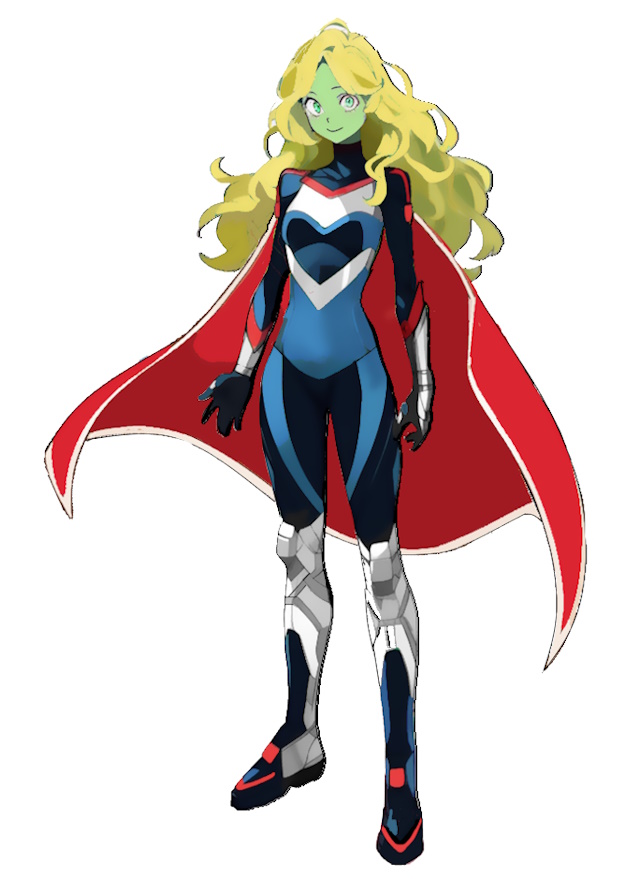
I am SUPER excited (heh, see what I did there?) to include this very special character in the 31 Days / 31 Character Challenge! I've been obsessed with the Deadline Heroes RPG for some time now so it was a given that I'd include a character from the game. Unfortunately, I've not yet run or played it.

Therefore, in a departure from my other entries for the 31 Days Character Challenge, this is an original character I created just for the 2024 edition. That's right, for a change of pace I'm going to do things the way they're supposed to be done! Inconceivable!

Did I mention I haven't been able to completely translate the rules for Character Creation yet? Anyway, let's go!


Character: Far Future Girl

AKA: The Tomorrow Hero, Alura Zordox

Player: None yet. Possibly me, possibly an NPC.

System: Deadline Heroes
 
Nature: Endless possibilities. 

Gamemaster: None Yet. Maybe me?

Circa: Today 2024

Origins: Again, I've been wanting to run or play this game forever but haven't been able to find enough of the material translated into English to make this endeavor viable. Luckily I am nothing if not persistent (read: obsessive, hyper-focused). I was recently able to find a number of resources,  including a set of Quickstart Rules (or 'Trial Set' as the website calls it), Actual Play reports, Sample Characters, and I ran them through a few translation programs. 

By essentially reverse-engineering some character temples and fan-made PCs, I was able to create Far Future Girl. It's me, so of course I knew I wanted her to be an Alien. As for powers, I wanted a classic Superhero of the American Flying Paragon variety. Messing with some AI Art designs to get some visual inspiration, I ended up with a character that, to me at least, reminded me of a Japanese Anime take on a Legion of Superheroes character. I liked one in particular and after some modifications, that's what I went with. 


Backstory: Alura Zordox was a new Superhero on her first mission after graduating from a Hero Academy in the campaign city...one thousand years in the future! She encountered a villain with a Time/Space Warping power and accidentally flew right into one of his portals. She popped out of a similar portal but in the 21st century!

Still going at her full burst flight speed, Alura slammed into the extraterrestrial villainess Kokorosa-Chan, leader of the Earth Invasion Society. Kokorosa had hypnotized a bunch of young male heroes and were having them walk into her own Time/Space gate when Alura crashed into her. The collision made Kokorosa-chan loose concentration. The brainwashed boys were freed but spent a few moments thoroughly confused. Suddenly, one of them shouted to Alura that Kokorosa-chan was a villain trying to take over the Earth!


Kokorosa-chan, Leader of the Earth Invasion Society
from the Deadline Heroes RPG supplement, 'Villains Showcase'


Zordox seemed to recognize Kokorosa-chan at that moment and hit her with a Thousand Year Punch! The other heroes shook off their stupor and together all of them were able to subdue the Earth Invasion Society and its leader. The guys cheered for Alura and soon introduced her to other heroes. After explaining she was from the year 302X, the modern heroes dubbed her The Tomorrow Hero: Far Future Girl!

Overview: I see Far Future Girl as a somewhat naive though very intelligent young woman who has quickly fallen in love with the 21st century. She loves to hang out with the other heroes, eat hamburgers and instant ramen, play video games, go to the movies, check out social media, and do all the typical things a normal young adult person does - all of which are completely new and foreign to her.

At the same time she is very confused by things we take for granted. You need a job to pay for food and shelter? Why? You still have trash? There's no Teleporter Booths to get around the world. How do you quickly travel to another country or to the Moon for a concert? What? No one lives on the Moon?!?

Alura misses her Mom and Dad very much, mentioning in passing they her father is a Superhero and her mother one of the smartest Super-Scientist's in the galaxy. She definitely gets homesick but also really enjoys being here in our present. Far Future Girl is a young hero torn. Should she stay in the 21st century or find a way to get back to her future?

The Highlights:

I don't have any yet as I haven't played her but I look forward to making some. I feel like Far Future Girl will be a really fun character to play. In my mind she's a mix of Supergirl and the Teen Titans Animated Series version of Starfire. 

Game Info:

As noted I don't have the full Character Creation rules available to me in English. Luckily, it seems that in Japan a common practice is to take one of the templates or sample characters, change their name and appearance to whatever the player prefers, and then run them from there. As the player and PC go on from scenario to scenario that character gains Growth Points used to improve and customize them further, resulting in a unique PC after initially being a 'copy' of a pre-made one. 

I was able to translate some of the sample characters, including a number of different 'Harbingers', the Origin type recommended for playing beings from another world such as Gods or Aliens (Thor, Wonder Woman, and Superman are described as examples of Harbingers). Kitbashing some of the these sample characters together and modifying some of the powers here and there (based on other powers from other characters) I was able to create Far Future Girl's sheet.


I'm not entirely sure how 'rules as written' accurate she is but it seems pretty close to other PCs I've seen. 

Her main abilities, Body, Spirit, and Environment, come from her Harbinger template, as does her Life, Sanity, and Credits. As for the powers, as I noted above, I took a few liberties with ones I had seen on the sample sheets. High Speed Movement (which I explain as Flight) is one that is directly from the game. Her Thousand Year Punch was inspired by the games' One Million Power. I made the punch less versatile then the power as written and I'm fine with that. Body of Steel is akin to the powers Armor Shield, Barrier, and Iron Body. Guardian is another power directly from the game (translated as Guard) but I was unclear how it works so I came up with a less powerful but more flexible variant. 

One thing I found really funny was that the Harbinger gets no Skill Level bonuses at all. The explanation is that these characters both rely on their powers and physical prowess more and are often unfamiliar with the mundane things a normal Human would have to do. 

Notes: 

In DC Comics, Alura Zor-El is the name of Supergirl's mother. Querl Dox is the true name of the Legion of Superheroes member Brainiac 5, an alien of the Coluan species and a descendant of the villain Brainiac. Far Future Girl's real name pays homage to Supergirl and Brainiac 5, who were a romantic couple in the Legion of Superheroes comic.

Taking some inspiration from this and the Japanese Anime 'Project: A-ko', I imagine Alura Zordox is the daughter of a genderbent version of the pair; a female Brainiac 5 and a male Supergirl (a variant Superboy I suppose. Superlad?).

The One Million Power that Thousand Year Punch is based on was definitely inspired by the power of the same name in the Anime/Manga 'Tiger and Bunny'. I additionally wanted a nod to 'Detroit Smash' and the other US city and state named super punches used by All Might and Deku in 'My Hero Academia'. 

Why did Alura recognize Kokorosa-chan? I'm thinking there is a villain in her future time of the same species. 

Legacy:

Me. Anime. Superheroes. How could I not like this?

It is heavily structured however, as are many modern Japanese TRPGs, and that might end up annoying me in the long run. Still, if there is a way to loosen it up a bit I would definitely use Deadline Heroes as a reoccurring and/or ongoing fill-in game for when we can't play one of our regularly scheduled campaigns. 


From the far future to modern day to a Medieval Post-Apocalypse Fantasy! Swords, Sorcery, and Giant Robots clash as we meet GARETH of OLLWOOD! 

Have at Thee! 

AD
Barking Alien


Wednesday, January 17, 2024

Superheroes - American Style

I've discussed the distinctly Japanese Tokusatsu genre of Superheroes already, so now I'd like to address Japan's take on Superheroes of the West.


As with Science Fiction novels, the first exposure to US published Comic Book Superheroes the Japan people would've had would've been from American Servicemen post-WW II. Superman was first published in Japanese in Japan in the 1950s. Manga anthology magazines began serializing American comics in the late 60s and early 70s. 

I can remember back in the late 80s and early 90s, when Anime and Manga were first making major inroads into the American market, that being an American fan of Japanese shows and comics was still considered very underground. Likewise, being a Japanese Otaku dedicated to America comics was similarly niche. 

Fanzines and Doujinshi covering Marvel and DC Superheroes did exist in this period, with the Wolfman/Perez run on Teen Titans and the Claremont/Byrne X-Men being especially popular among a small but growing Japanese audience. 


Batman Manga - Artist Jiro Kuwata
1966-1967

My friend Rina had collected some of these doujinshi and brought them to show me when she visited the US during the Summer. The younger brother of a girl I later dated was a Star Trek and X-Men fanatic for sure and that was around 1995-96.

Of course, the widespread popularity of American Superheroes was kicked into high gear thanks to TV shows and Movies. The CW programs featuring Green Arrow, the Flash, Supergirl and others brought the genre to the masses, though that pales in comparison to the films in the Marvel Cinematic Universe.


Marvel Superheroes by My Hero Academia Creator Kohei Horikoshi.


At the same time, the MCU doesn't top the charts in Japan the way it does in the West and indeed elsewhere. To understand why might take a deeper dive into the subject than this post is meant to cover but it definitely has roots in Japanese culture and preferences. Key factors include Japanese protagonists tend to be younger, they are often awkward underdogs who take a while to get good at their special abilities, and the designs and other visual are just very different from what Japanese fans have come to expect in their Pop Culture Entertainment. 

That said, there are those creatives in Japan who truly love American Comics and have found a way to make them appealing to a Japanese audience. Just look at the work of Kohei Horikoshi, the writer and artist behind one of Japan's biggest Anime and Manga hits in recent years, My Hero Academia. Not only has he created a successful series of Manga based on the Western Superhero with a Japanese twist, it has been made into a popular Anime TV series, a few Anime films, and a number of spin-off Manga (I am particularly fond of My Hero Academia: Vigilantes!). 

He's not the only one. There's Tiger and Bunny, One-Punch Man, and a Manga series from last year the became an Anime back in October called SHY, just to name a few of the most well known examples.


Left: My Hero Academia: Vigilantes
Right: SHY


So what about American Style Superhero Role-Playing in Japan? Well, this looks like a job for...


Author: Takashi Nagata
Studio: Rommel Games
Publisher: Rommel Games / Fujimi Shobo

Deadline Heroes, while not a major player in the Japanese TRPG market, has a dedicated fanbase that appears to absolutely love this game. It has a number of supplements and pre-made adventure scenarios both official and fan-made. Personally, I can see why...

Deadline Heroes differs from other Japanese Superhero Tabletop RPGs in that it really isn't a 'Japanese Superhero' game at all. It's an American Superhero RPG made by Japanese creatives. Most of it's tropes, mechanics, and even the look of its pre-made heroes and villains are more in line with Western Comic than Manga. Well...sort of.

If you've watched Japanese Anime or read Manga such as One-Punch Man, Tiger & Bunny, and My Hero Academia you'll notice that the Japanese depiction of Western style Supers, especially the villains, is very distinctly Japanese. Most Supervillains are quite monstrous in appearance (though not all) and the costumes worn by many of the good guys are more over-the-top than even the most avant garde American heroes. 

Still, this game and the genre it seeks to represent is undeniably clear; these are masked crimefighters in colorful outfits using their wits, weaponry, and wonderous powers to protect the citizens of this fair city from criminals, catastrophes, and would-be world conquerors. 


Not Wolverine, Isn't Scarlet Witch, Different-from-Iron Man,
Definitely-Not Black Widow, No-Where-Near Hulk, and Nearly-But-Not-Quite Thor
would like a word with you evil doer!


The game first came out in 2013-2014 and somewhat uncharacteristically [for a JTRPG] uses both D10s and D6s. The game is generally viewed as very easy to learn and play. Character Creation works by choosing a Superhero Origin which gives you your Stats and the kinds of Superpowers, Equipment, and Abilities you have access to. Next you pick the options that add details you want for your character.

The Superhero Origins are:

Enhanced: Someone given powers through accident or experiment. Super Soldiers, Hulks.
Harbinger: Beings from beyond our world or dimension. Aliems, Gods. 
Justicar: A normal person with super training and discipline. Dark Detective, Amazing Archer.
Mystic: A person with magic spells or supernatural powers. Sorcerers, Witches.
Scion: A member of a superhuman race or species. Mutants, Atlanteans. 
Technomancer: Technology and the power of science! Armored Heroes, Cyborgs.


Additional elements of Character Creation figuring out ones Powers, Skills, Credit, Grit, and Sanity (the last three are types of game mechanic currency). One of the things I love is as these resources dwindle you get closer to unconsciousness and death but also get a bonus to your effectiveness as you become desperate to win, hence Deadline Heroes.

As with many Japanese TRPGS of the last decade, the game uses a ;phase system' to progress the session's events. During the Introduction Phase characters entered the story and determine what is going on. It is the discover and investigation part of the scenario. After that you enter the Deployment Phase and complete various Challenges. If your hero or team can best these Challenge you move on to the Decisive Battle Phase where you'll face off against the villain(s) of the adventure. Be warned! Fail to beat any of the Challenge events in the previous phase and you'll start your Decisive Battle at a disadvantage. Great Scott! 

Another thing about Deadline Heroes I find really interesting is that the studio that makes it, ROMMEL GAMES, produced about a half dozen sourcebooks, supplements, and scenarios in house while the rest are fan made and then published through them. The game is almost entirely supported by the Doujinshi market and the fans of DLH have really made some great stuff. 

Some of the current supplemental material includes:


School of Madness

A supplemental including new rules, character creation options, and a very cool setting that gives Deadline Heroes its own 'My Hero Academia' 

Villain Showcase

A collection of adventure scenarios, each introducing a new villain organization and their leaders. 

There is a very distinct flavor to the villains of the game and its one you do see reflected in other Japanese Superhero content. Manner of them seem especially monstrous, particularly in appearance  I could probably do an entire post just on this subject.

Find Weakness

Adds the concept of Weaknesses to the game, giving your hero bonuses for being allergic to alien rocks or unable to harm things made of wood. 

Power to the People

Mainly a selection of new options, powers, and scenarios, there seems to be a focus on street crime of the Batman and Daredevil variety. 

In conclusion (for now), Deadline Heroes is a really intriguing look in Japan's American Superhero Fandom as well as its RPG culture. I really love some of the ideas in this game, while others are too heavily structured for me personally. I would love to tinker with it to adapt it to something more in line with my approach to Supers RPGs. 

To that end, get ready for something a little different as I try to create a Deadline Heroes character for my next 31 Day Character Challenge entry.

Go Justice!

AD
Barking Alien


Sunday, January 14, 2024

31 Days / 31 Characters - DEE HOSHIYORU

Creguian (pronounced KREG-e-on) is the name of a Japanese Play-by-Mail Role-Playing Game that began in 1990 and continued on until the parent company Hobby Data went out of business suddenly in 2003. Over the 13 years that Creguian ran, the game became incredibly popular, resulting in a Tabletop RPG boxed set released in 1992.

Additionally, a second boxed set expansion, a softcover supplement, and a dozen published scenarios were produced. Numerous light novels based on the background events of the setting were published as well. Over the course of its 10+ years, the actions of its player base generated and developed the characters, equipment, and events of the game's universe as much as any material issued forth by those running the PBM. 

At a NJ gaming convention in 1992 I met a fellow whose older brother was in the military and had been stationed in Japan for some time by that point. We got to talking about Japanese RPGs and he mentioned his brother playing Japanese made games as well as one or two that were PBM. The older brother had sent some of the tabletop games back home to his younger sibling and in fact, the fella had brought some of these games to the show. We met after the convention for dinner and he pulled a few JTRPGs out of his backpack: Sword World, Horai School Advenure, and none other than Creguian. I'd seen ads for Creguian in Japan's Dragon Magazine and it had always intrigued me. 

The guy ended up running a session with myself and two friends and it was great, largely because of the world building. The Creguian setting was very interesting to me. I honestly don't recall the rules very well, except that it reminded me of classic Traveller, though if I recall correctly it was 2D10 instead of two 2D6 for resolution. That or it may have been a percentile system but I distinctly remember getting a strong Traveller vibe from the game. Before the con ended, this guy was able to photocopy some of the English translation pages and gave them to me. Combining these notes with MegaTraveller I was able to run a short Creguian campaign of my own a week or two later. It rocked and featured this awesome character by a very cool gal I used to know...


Character: Dee Hoshiyoru

AKA: Lady Star, Starlight.

Player: Sasha

I think. I can't clearly remember her name. I can picture her in my mind like our last encounter was yesterday when it's got to be 30+ years since I last saw her. She was of mixed-heritage; her father African-American and Latin-American, her mother Caucasian and Japanese. She was strikingly attractive. 

She always wore a black leather [motorcycle?] jacket, biker shorts, and either a punk band or comic book related t-shirt. That's all regardless of season or temperature btw. Overall she looked like a rock-n'-roll fitness instructor, which incidentally she was. Her day job was as a personal trainer. 

System: Creguian, Tabletop RPG / MegaTraveller.
 
Nature: Short Campaign: Homeward Bound

Gamemaster: Adam Dickstein

Circa: 1992

Origins: I remember discussing my experience playing Creguian with a friend at my job [at a Sci-Fi/Fantasy Book and Comic Book store] when another regular customer standing nearby, Sasha, said how cool it sounded. All three of us got to talking and decided to get together to run a game. Adding two others, we ran a trial session; basically a one-shot just to show everyone what the game was all about. Sasha asked me, "So what happens next?". Checking with the others to see if anyone else was interested in answering that question, I got a resounding 'let's find out'. 


 The Creguian RPG Boxed Set 
Cover and Contents.


Backstory: Dee Hoshiyoru was a drifter with a past she would rather not talk about, moving aimlessly through the stars of the Frontier Sector trying to survive and forget. Although everyone she ran into out there could tell she was native to this life, that she was destined for or came from higher status, no one could argue she didn't belong. Hoshiyoru could hold her own.

On a routine job guarding Outer World cargo headed for the Inner Sphere, Hoshiyoru saw a ghost, someone she thought was long since dead. The daughter of the altruistic, wealthy, corporate nobles who'd raised her was being forced to board a starship of ill-repute. Dee believed she had failed her family, that everyone had been murdered but no, the youngest daughter had survived! 

Banding together with a charming conman Smuggler, a cyborg Mercenary with a Mech, and a dying alien Baptist Psychic, Dee Hoshiyoru - or Lady Star as the Smuggler liked to call her - set out to right what she felt was her greatest wrong so she, the noble's daughter, and all her new friends could be Homeward Bound. 

Overview: I can best describe this campaign as 'Star Wars as written and directed by Blade Runner era Ridley Scott'. Each PC had a reason to chase this group of Interstellar Organized Criminals with the separate but unified goal of 'getting to go home'. For the Smuggler, the crooks had cheated him out of a score that would pay off his debts so he could return to his home planet. The Merc swore he wouldn't return home until he got revenge for the death of his brother. The alien was one of the few members of his species left in the galaxy. The entire race was going extinct. Dee's noble corporates had developed a medicine [of some sort] that might prevent this.

Lastly, Dee is revealed to have been an orphan taken in by the corporate family and raised by their Chief Of Security as his own daughter. She eventually became Security Head herself. One day, a surprise attack on their home ended with the murder of the entire group by a guild of assassins working for a business rival. With her family gone, her reputation in ruin, and even some suggestion by the media that she might have been in on it, Dee ran. She eventually lost herself on the frontier, which is where we see her when the game starts. 

Her real name is actually something different but her adopted father always called her 'Hoshiyoru', which in Japanese means Starlight. 


The two major Creguian expansions:

On the left; a second box set detailing Starship Construction, Space Battles, and other Starship stuff.
On the right; Crisis Point, a soft cover, saddlestitch sourcebook and scenario generator. 


Highlights:

Dee would have interesting, though brief, philosophical discussions with our alien character. His species is referred to as the Baptists (See Notes below). Often his side of the argument would be about the universe have a plan for all of them and they it was all tied to destiny. Dee was of the opinion that the sentient universe the Baptist believed in was either not real or a terrible planner. "This thing has to be the worst tactician ever."

The Smuggler flirted with Dee quite a bit and she back but made it clear at one point that it wasn't serious. He was disappointed but they remained fast friends. In a session towards the end when Dee makes it obvious she's romantically interested in the noble daughter and had been for a while in their adult years, the Smuggler basically sacrificing himself so Dee can rescue the young woman and escape. His last words were, 'After all this, someone deserves a happy ending. Right?"

Game Info:

Unfortunately I can't find any of my character sheets or rule notes on this game (typical of me, I know. I save write-ups of the stories and characters but rarely prioritize archiving mechanics). I did decide to record this character as if she was a Traveller/MegaTraveller PC though so here you go:


Dee's Starlight Armor would basically act as Combat Armor-TL 12, giving her an Armor Value of 10. It adds a +1 to Strength, Dex (but not towards Ranged Weapon Accuracy - only Speed, Agility, and Reaction Time), and End. She can activate a 'Star Field' mode that increases her Str, Dex, and End to +3 and +6 on a Critical Success. Armor Value increases to 30 at this time (a super-charged force field effect). The Critical effect lasts 3 rounds and then the suit gives no bonuses, none at all, for 3 rounds. Following this it returns to normal. It can only be used 3 times in 24 hours. 

Trying to fill this out I realize how different the two games and universes really are. Like most Japanese protagonists, the PCs of Creguian skew younger than those of Traveller. For a starting Traveller Player Character to be competent, let alone proficient, they'd have to have at least a few tours of duty and be someone between 34 and 42 at least. At 24 Dee was one of the two oldest members of the team and was probably more skilled than I made her out to be above, even with fudging the numbers. Really, the above sheet was just for fun and isn't a good example of a Creguian character (or a Traveller one for that matter). 

Notes:

First, the word 'Creguian': It is a word in the alien language of the Baptists, the first extraterrestrial intelligence Humanity encountered. Directly translated it means, 'one who plots'. It is their word for Humans; we are Creguian. Unlike the calm, organized, and pragmatic Baptists, Humans are full of curiosity, determination, and daring. We are viewed as wonderfully energetic and dangerously unpredictable. We are part of the reason the Baptists are in danger of extinction. 

The Baptists get their name - given to them by Humans - for their belief in a sentient universe, which they see as a deity. A rite of passage in their culture involves total immersion in sea water until they nearly drown. If they survive it, they are renewed in body, spirit, and purpose. 

The game has numerous nods to Judeo-Christian names and mythology, attributing this to what survived after the Great War. There aren't necessarily major religious themes however. It's mostly just window-dressing. 

The setting takes place three thousand years in the future and is generally referred to as 'The 3000s'. This is the era after The Great War ended that pitched the galaxy backward technology wise. Although we are in a far future, starfaring, cyberpunk heavy era, a key element of the setting is that Humanity used to be even more advanced. Finding lost technology and abandoned colonies is a common theme (as in the Third Imperium of Traveller). 

I had this idea that each player had a secret 'Power Up' (though I don't think I called it that). If and when they were willing to spend X amount of experience points, they would unlock some cool feature of themselves or their gear. The Smuggler's ship had a hidden pre-Great War Tractor Beam. The Cyborg Merc could unlike a Flight Mode on their Mech they let them, well fly obviously, but also had considerable speed and maneuverability. The alien could 'Commune with the Cosmos', allowing him to ask the GM a question that was almost meta. For my part I had to tell the truth, though I could give an incomplete answer. 


A Creguian Mech Pilot and their Mecha Suit


Hoshiyoru's 'hardsuit', a low-level powered armor that boosted her strength, speed, and toughness, could activate a sparkling force field of golden stars that gave her a small bonus on those things and a huge bonus on a Critical Success (as noted in more detail under Game Info above). 

Legacy:

I've love to run another game of Creguian, as I would an Anime/Manga themed game of almost any kind really. Going through this project I'm realizing how much I miss the days where these games were more common place for my groups and I. 

When I started searching for information and images on this game I thought, 'I'm not gonna find anything. I'll be lucky if the Japanese websites remember it.' I mean, let's be honest. before this post had you every heard of Creguian? This was a Play-by-Mail game, only in Japan, that had only a handful of physical RPG products (not including the tie-in novels), and it ended over 20 years ago. 

Then I found this...


The New Creguian is a reboot/sequel to the original game by new publisher Frontier Works. It seems to be set up as a Play-by-Web game, though further research seems to indicate a tabletop RPG is something they're considering. 

We...the Creguian...live on.


Look! Up in the sky! It's a heron! No, it's a Mitsubishi F-X! No! It's something very different for this challenge...a brand new character! Introducing FAR FUTURE GIRL!

AD
Barking Alien


Saturday, January 13, 2024

Space is for the CREGUIAN


Science Fiction in Japan can be traced all the way back to the year 720 and a time travel fairy tale called Urashima Tarō, a story not unlike the Western world's Rip Van Winkle. In it, a fisherman rescues a turtle who rewards him by taking him to the Dragon Palace, a supernatural place populated by the Dragon God and other such beings. There he is entertained by a princess and after several days of the most wonderful hospitality returns home to find between 100 or 300 years have passed (depending on the telling). His home is a ruin, his family long dead, and he himself forgotten.

Another early story tells of a princess from the Moon, taken to Earth for her safety as the heavens erupt in a celestial war. She is cared for on Earth by a humble wood-cutter. When her true family returns to bring her home, they do so on a large bright disk resembling both the Sun and the typical early depictions of flying saucers.

Modern Japanese Science Fiction finds its roots in the Meiji Restoration Era of Japanese history (agreed by scholars to be from 1868 to 1912). Among the first novels of Western origin translated into Japanese and widely distributed were those of Jules Verne. The term 'Kagaku Shōsetsu' or Science Novel was put forth in the late 1800s and became a popularized name synonymous with what we know of as early Science Fiction.


Fantastic tales of undersea warships and rifts in space carried the literature movement through the early 20th century and all the way to the Second World War. With Japan's defeat and the horrific nature of the weapons used to accomplish this task, Japan's Science Fiction changed and evolved. Among the first to usher in this new age was not a novelist but a manga artist, none other then Osamu Tezuka, considered the 'Godfather of Manga' and the creator of Tetsuwan Atom (Astro Boy) and Black Jack, among many other works. Tezuka's early successes, such as The Lost World and Metropolis (1948-1949) were a major influence on Japanese Science Fiction authors of the period. 

The first full-length Japanese SF novel was Inter Ice Age 4, written by Kobo Abe, an accomplished playwright, musician, and inventor. Abe's writings have been compared to that of Frank Kafka. As more and more writers started to embrace the genre and Japan began to climb back from it's wartime conditions, interest in Science Fiction increase considerably. While periodical struggled to capitalize on the phenomena the way American companies did in the 1950s, novels did very well. In addition, American troops stationed in Japan brought their own interest in SF with them and by the 1960s many of the Western Science Fiction authors beloved in the US were also very much appreciated in Japan. 

Sci-Fi exploded in the late 1960s and 1970s with the expansion of manga, early animation, and the release of the Star Trek TV series, the first Star Wars film, and the first real Light Novels. Magazines made another attempt to impact the market and were more successful this time around. Before long the audio and visual mediums of movies and television surpassed the literature element of SF in Japan, thanks largely to Anime and Manga. Unfortunately, in the view of some Science Fiction literature scholars and enthusiasts alike, the line between novel, light novel, and other forms of SF blurred in the 80s and 90s, which caused the genre to be taken less seriously as an art form. 

Soon after the Science Fiction genre gradually dropped in popularity, with Japanese audiences looking for something fresh and the various entertainment industries not knowing how to respond. At least in the publishing business. SF Anime and Manga remained popular if not particularly deep or innovative in the mainstream.

The first Japanese Science Fiction Tabletop RPGs appear in the early 80s. Enterprise, a Star Trek RPG made entirely in Japan, is not only the first SF game but possibly the first stand-alone Japanese TRPG ever, coming out in 1983. Crusher Joe, based on a series of novels first published in 1977, received two RPG boxed sets in 1983 as well to coincide with the release of an animated film. Japanese language editions of Traveller and Star Quest came out the year after, with Traveller being especially popular. Interestingly, the covers and illustrations in the Japanese Traveller books were done by Naoyuki Kato, an artist best known for painting the covers of many Western SF novels when they were translated in Japanese [such as Dune, The Stars My Destination, The Forever War, and more]. 


In the 1990s, with Cyberpunk and Mecha stories dominating the Science Fiction scene in Manga, Anime, and elsewhere, it isn't surprising that we see the same thing in gaming. The first real Mobile Suit Gundam RPGs appear at this time, with Dainihonkaiga publishing the Gundam Sentinel RPG in 1990 and a classic MS Gundam 0079 expansion in '91.Tsukuda Hobby would publish their own Gundam game in mid-to-late 1990 but it was really more of a wargame akin to Battletech. Also in 1990 Hobby Japan puts out one of my all time favorite Japanese TRPGs, Metal Head; Cyberpunk meets Space Adventure. Gear Antique, another game I very much enjoyed debuts in 1991. Finally, the sadly lackluster Multiverse comes out in '91 as well. A rather bland game that doesn't deserve it's cover by the amazing Kenichi Sonoda.


In 1992 we get CREGUIAN, Tabletalk RPG in the Far-Future, a fascinating game best described as an alternative Traveller. I'll be talking a lot more about this one in my next post. A boxed set RPG called Space Opera Heroes and its sequel, creatively titled 'Space Opera Heroes 2', are both published in 1992. Fun if not particularly innovative or interesting tongue-in-cheek SF. 

American RPGs Mechwarrior and Cyberpunk hit Japan in 1993, though like its wargame predecessor Battletech, Mechwarrior got a huge make over for the Japanese market. A major entry comes in 1993 with Tsukuda Hobby's Tokyo Nova, the Cyberpunk RPG with spiritual/supernatural undertones which would become far more prevalent in future editions of the game. Tokyo Nova uses Playing Cards instead of dice. The second edition came out in 1995 and the quite revamped third edition was put out in 1998 under the title, Tokyo Nova: The Revolution. Lastly, in 1994 Japan's Dragon Magazine publishes Paradise Fleet, a Space Opera that had originally been published in monthly installments in the periodical. It was, in essence, the first crowdsourced TRPG I'm aware of. Certainly one of the first in Japan. 


Japanese Science Fiction went through another change in the late 90s and throughout the 2000s. Publishing companies, experiencing a fiscally weak market at the time, were eager to try something different in order to make money. A push was made to get Science Fiction back out there in a big way. Two of the major publishers, Tokuma Shoten and Kadokawa Haruki, created writing contests for SF literary achievement awards and it worked. Science Fiction short stories and essays by the likes of Satoshi Ito and Toh EnJoe were published, renewing interest in the genre. This eventually lead to a Sci-Fi renaissance and in 2007 the 65th World Science Fiction Convention, more commonly known as WorldCon, was held in tandem with Nihon SF Taikai* in Yokohama.

The popularity of the genre hasn't ebbed since and in fact, the 80s-90s lament of the blurring lines between Pop Culture Entertainment and High Literature are now embraced. We get to see fun and entertaining books and light novels along with philosophical Anime and Manga. Self-publishing, E-books, and User generated Web Novels allow for more variety, versatility, and exposure than ever before. Animated films previously considered independent arthouse approaches like Your Name and Suzume by Makoto Shinkai are major motion picture industry hits, grossing many hundreds of thousands of dollars worldwide. 

In addition to more translations of American games, there were quite a number of cool titles appearing between 2004 and just prior to the pandemic. Among the ones that really caught my attention were those from Japan's indie/small press market, including  Doujinshi games. Fun RPGs like The Trouble with Aliens (Resident Alien the RPG?), Lost Record (Secretly kind of dark), Metallic Guardian (Japan's answer to Mekton), and Space Ship Story (Rules-lite Sci-Fi in the vein of Captain Harlock and Ulysses 31). 


Also, got to give a shout out to Spaceship Star Truck. Love the look and the concept.


Wonderful! Fascinating stuff. Only one question...

Yes Barkley?

You put Creguian in the title of the post. I understand that its one of the earliest, biggest Science Fiction RPGs of Japan but why does it deserve to be in the title? Also, what exactly is a Creguian?

Ah, excellent question! The answer to which lies in the next 31 Days / 31 Characters post...

AD
Barking Alien


Thursday, January 11, 2024

31 Days / 31 Characters - CRIMSON CYCLONE CYBERO

Crimson Cyclone Cybero was a character my buddy Aldrin originally created for a game we only ran a single session of and then couldn't seem to get around to scheduling. I think his original name was Crimson Hurricane and he was a homage to DC's Red Tornado. He was randomly rolled up for a Villains and Vigilantes game with the premise that the PCs were a team of international heroes. Crimson Hurricane represented Myanmar (Burma at the time) but it might also have been the Indochina region. Buzz really liked him and wanted to use him for this other game so I said sure, since I liked him too. 


Character: Crimson Cyclone Cybero

Cybero is pronounced sigh-BEH-row.

AKA: A Secret Identity (that I don't recall). 

Player: Aldrin 'Buzz' Aw

System: Mekton RPG, 1st Edition and Villains & Vigilantes, 2nd Edition kitbash.
 
Nature: Short Campaign: Super Savior Cybero

Gamemaster: Adam Dickstein

Circa: 1985-1986

Origins: I spent some time over one Summer with my Dad and where he lived he got foreign language TV stations if you messed with the antenna and channels a bit. I discovered and was able to watch Kamen Rider in Spanish and Ultraman in either Chinese or Japanese (depending on the day). I think I was also able to catch one of the Sentai programs as well. 

Sometime after running my first 'campaign' of Mekton (if you could really call it a campaign), I wondered if there was a way to take parts from R. Talsorian's Mecha game and glue them into the Superhero RPG that was 2nd Edition V&V in order to run a Tokusatsu RPG. It worked! OK, it worked 'cause I made it work and probably fudged some things. Maybe a lot of things. We got a good game out of it didn't we?


Backstory: When Doctor Simon Date invented the Cybero Circuit, a revolutionary Organic Computer far ahead of its time, he completely changed the field of cybernetics overnight! Unfortunately, the benefactor funding his research was secretly Catastrophe-X, leader of the would-be world conquering organization 'Armageddon Genesis'. 

With the help of his assistant Sana and his daughter Sadako, Dr. Date had just enough time to complete his three Super Cybero Savior projects and escape with them before X's minions arrived. Now, protected by this trio of cybernetic superheroes, the group tries to take down Armageddon Genesis and defend all mankind!

Overview: The campaign was very episodic, with each session following a basic format; either Armageddon Genesis would send agents to capture or kill Dr. Date or his Daughter and the PC heroes would have to protect them - or - the heroes would hear reports of a peculiar crime or occurrence and go to investigate, uncovering some scheme by AG to take over the planet.

The villains would consist of a half dozen to a dozen faceless goons and 1-3 'lieutenants', more formidable opponents using Super Weapons and Armor or else being Super Cyborgs themselves. 

As far as the PC good guys we had:

Protector Cybero Paladin - Blue, White, Gold - A normal but skilled young man wearing an 'Iron Man' type Powered Armor. He had Super Strength, near Invulnerability, a multi-setting Raygun and a Power Sword that delivered stunning blasts. The Cybero Circuit gave him mental control over the suit - he can change the settings on his weapons with a thought for example. He was basically our Captain America/Superman boy scout.

Cybero Midnight Mask - Purple, Black, White, Gold - was a cyborg whose enhancements were undetectable until he donned his special mask. Midnight Mask's cybernetics gave him 3x the strength, speed, and agility of a normal Human. He was equipped with numerous crimefighting gadgets like a tricked out Motorcycle, Throwing Disks, Shock Tonfa, Smoke Bombs, and Power Inhibitor Handcuffs. The Cybero Circuit activated his cybernetics and let him remote control his motorcycle. Midnight Mask was our cynical and grim detective in the vein of Kamen Rider and Batman. 

and last but not least...

Crimson Cyclone Cybero - Red, Black, Gold - is a full android and he was built before Dr. Date realized his work was being funded by a Supervillain! The prototype designs were shown to Catastrophe-X in his secret identity and as such were copied by Armageddon Genesis to create some of their powered minions. However, the good Doctor kept tinkering and eventually created a unique sentient machine. His primary power is Super Speed, able to travel so fast he appears to be a blur of red light. He can also move quickly, not just run quickly, giving him the ability to perform multiple attacks and catch or deflect projectiles. Crimson Cyclone can also use his speed to build up wind, creating powerful gusts and striking like a 'living' tornado. His Cybero Circuit allows him to transform into a normal looking person and he does have emotions. His personality is split; in battle he is a cold, calculated, and no non-sense, though still heroic and honorable. Out of combat he is like a child, a Data-like Pinocchio learning to be Human. A little Silver Surfer is in there as well. 


Three of the major inspirations for Crimson Cyclone Cybero
(Left to Right) Android Kikaider, Joe from Cyborg 009, and The Red Tornado


The Highlights: 

It is difficult to recall many of the game's specific moments. It was so long ago, a campaign of no more than a dozen sessions, probably less, and there were so many other games going on at the time. Even so...

I recall one really good session where Sadako, Dr. Date's daughter, had been kidnapped by the bad guys and ransomed. Armageddon Genesis would return her if Date handed over the blueprints for the Cybero Circuit, otherwise she would be killed at dawn! The heroes discovered the location where Sadako was being held and went to rescue her but it turned out to be a trap! The real Sadako was hidden somewhere else and the one at the place the PCs went to was an android duplicate. Worse yet, one with Magnetic Powers! 

The battle was extremely difficult, as Crimson Cyclone and Protector Paladin fought the Iron Maiden (her code name) while Midnight Mask sneak into the place where the true Sadako was held. MM had to fight through a bunch of goons and traps all on his own before being confronted by a major lieutenant. Meanwhile, the other two PCs had a tough time being Metal Heroes against the Mistress of Magnetism. 

What turned the tide was when Crimson Cyclone started to ask her why she was doing this, fighting against another android such as himself. She replied that it was her programming and what she was designed and built to do. CC got all existential on us, discussing what it meant to be an Artificial Intelligence and whether the fight was logical if you were going to think like a robot or decent and compassionate if you were going to think like a true living being. As she starts to get second thoughts about her role in all this, the villains signal that they're going to blow up the base with Cyclone, Paladin, and Maiden inside it. Cyclone appeals to her better judgement once more and convinces her to work with them to get free.

Just as Midnight Mask and his opponent duel to a standstill, Crimson Cyclone, Protector Paladin, and Iron Maiden blast through the ceiling to come to MM's aid. The heroes, including Sadako, depart after defeating their enemy and Cyclone asks Maiden to come with them. She declines as she must discover who she is now and what her purpose is but she assures them they'll all meet again. 

Game Info:

After running a lot of Villains and Vigilantes and then a lot of Mekton, it just struck me that if you mixed these together you could cover those Metal Hero series style characters. Now, how did I do it? What did it look like? Beats me...

It was a long time ago and I don't think I ran any other games with this particular kitbash. If I remember correctly, it was mainly Mekton with the powers from V&V stapled on and adapted to work with the former. Somehow.

Notes:

This was one of many games I ran between the mid-80s to the mid-90s that was initiated because I just really wanted to run a game about whatever the heck I thought was cool that month. Most of the time this worked because I was playing with people who also thought those things were really cool. I also had a number of people who didn't care to know anything before being introduced to it during play. I miss those days. Everyone now needs a 10 page write-up on the world background and mechanics in order to even consider playing a suggested game. Seems our sense of adventure only extends to our characters in their settings and not to the players in the real world. Sigh.

Thinking back, I wonder if the rules I stitched together actually worked or whether we all just agreed to pretend they did. It was an unholy mish-mash to be sure but it made sense to us at the time and I guess that's all that matters. 

Doctor Date's name is pronounced Dah-TEH. It is a Japanese family name that means Intelligent

I forgot to mention, one ability all three PCs got from their Cybero Circuits was to instantly change into their 'costumes'. Midnight Mask's Cybero Circuit was on his belt and activating it summoned his mask/helmet to him. Once putting it on he fully transformed. Protector Paladin's was on his wrist I think. Crimson Cyclone's was in the center of his chest a la Tony Stark's Arc Reactor. 

Legacy:

As mentioned under 'Origins', Crimson Cyclone was first created for a V&V campaign featuring international superheroes. He has since appeared or been mentioned in that capacity in various Supers games I've run over the years. More often than not its a name drop when discussing what Superheroes are around or available in the area of Southeast Asia. 

I've always liked this character and still do, though I haven't thought about him in a while. I am sure some version of him is out there in the Multiverse somewhere, defending Humanity while still trying desperately to fully understand it.

Not unlike myself I suppose.


From live action Superheroes to Space Opera Anime - tag along with dangerous DEE HOSHIYORU and face the Cregurian!

AD
Barking Alien