Saturday, December 31, 2022

Many Small Moves Make A Pokemon Master!

This post was written yesterday, December 31, 2022 but I got so tired while editing it my eyes went blurry. I have posted it as such, the final post of last year, mostly for aesthetics and OCD reasons understand by no one other my own subconscious. It was completed on January 1, 2023.

Thanks for putting up with my weirdness.

These Mechanics were largely inspired by the Mobile Games
Pokemon Masters and Pokemon Masters EX.


Back to Pokemon AD and the conclusion of Character Creation!

One of the things a Game Designer learns during the process of creating an RPG system is how many pages it takes to explain rules, even if those rules are relatively simple. Here we have a fairly rules light game and this is the fourth entry on just creating a Player Character! Technically the fifth post if you include my rule change regarding PC improvement. Gah!

Anyway...

On the final day of 2022, New Year's Eve, we reach the last key section of the Character Creation process - Trainer Moves and Inventory:



Trainer Moves are similar to Feats and Talents in other games. They shake up the situation with effects that allow the PCs (and Major NPCs) to benefit themselves, their Pokemon, their allies, and their allies' Pokemon. In some cases Trainer Moves can hinder your opponents or an opponents' Pokemon. 

There are a lot of Trainer Moves and the purpose of this entry isn't to list them all (though I probably will soon so don't worry) but rather to explain how they work. I will of course describe a few of them by way of example. 

Trainer Moves consist of:

  • The name of the Move
  • The number of times it could be used in a Battle/Scene and the Story Point Cost.
  • The Target - Self, Pokemon, Ally, Allied Pokemon, Opponent. Opposing Pokemon
  • The Type of Move - Attack, Defense, Enhance, Heal, and Hinder.
  • Description - What the Move does and how it works. 

When a PC has an available Action and they want to execute a Trainer Move, the PC spends the required number of Story Points and states which Move they are using. The Move then happens, its effects changing the situation the PC is in, be it a Battle, a Contest, or some other situation in which they and their Pokemon are working together towards a shared goal. 

Most Trainer Moves require 1 Story Point to be spent and can only be used once in a Battle or Scene. There are some powerful Moves that require more than 1 Story Point to activate. Others can be used twice in a single Battle or Scene with the cost of only a single Story Point.

Furthermore, most Trainer Moves are Instant, occurring immediately and lasting only as long as the Target's current or next Action (as noted under the Move's details). Others can last from the moment they are initiated until the end of the Battle or Scene. Check the Trainer Moves' Description for information on duration but the general rule is they happen on your Action and then they're over. 

The Target is pretty self-explanatory. Trainer Moves always have a Target. They must directly effect someone or several someones - a person, a Pokemon, a group of people, or a group of Pokemon. The more Targets a Trainer Move effects the more likely it is that the Move will have a higher Story Point cost or great specifics on how, when, and how often it can be used.

The Type is mostly a way of tracking the various Trainer Moves but it also helps the players and GM know the purpose of the Move. Attacks and Defenses are generally used in combat and to counter the opposing Move of another. A Heal is similar but it's important to know that a Heal Trainer Move is what it is and not the use of a Healing Potion or a Heal Return, as those use different rules. Enhances buff or improve allies and allied Pokemon, both yours and others. Hinders are debuffs that weaken an opponent or an opponent's Pokemon and make them less effective. 

Description gives you the the ins and outs associated with each Trainer Move and what happens when it's used. As Trainer Moves are all about boosting things, weakening others, and changing the rules (by the rules of course), the magic is very much in these details.

Note that a number of Trainer Moves operates with very specific conditions that must be met in order to use the ability. These are noted where appropriate or under the Move's Description. 

Example: Surge of Power only works on your own Electric Type Pokemon, so under Target it would say 'Pokemon (Electric Type)'. Clear Your Mind heals Stress from an ally (but not yourself) but requires the Trainer be Psychic. The Target would read 'Ally'. Under Number of Uses/Cost it would say '[Psychic] 1/1'.  

Format-wise if there is a word in brackets [  ] after a number or piece of text it refers to something connected to a PC ability. If there is a word in parenthesis ( ) it refers to something related to a Pokemon . Often Pokemon Types will be identified with Type Symbols (see next Pokemon AD post for more details).

These are the basics and as I noted above, I'll be putting out a list of Trainer Moves very soon and probably give additional information on them as needed.
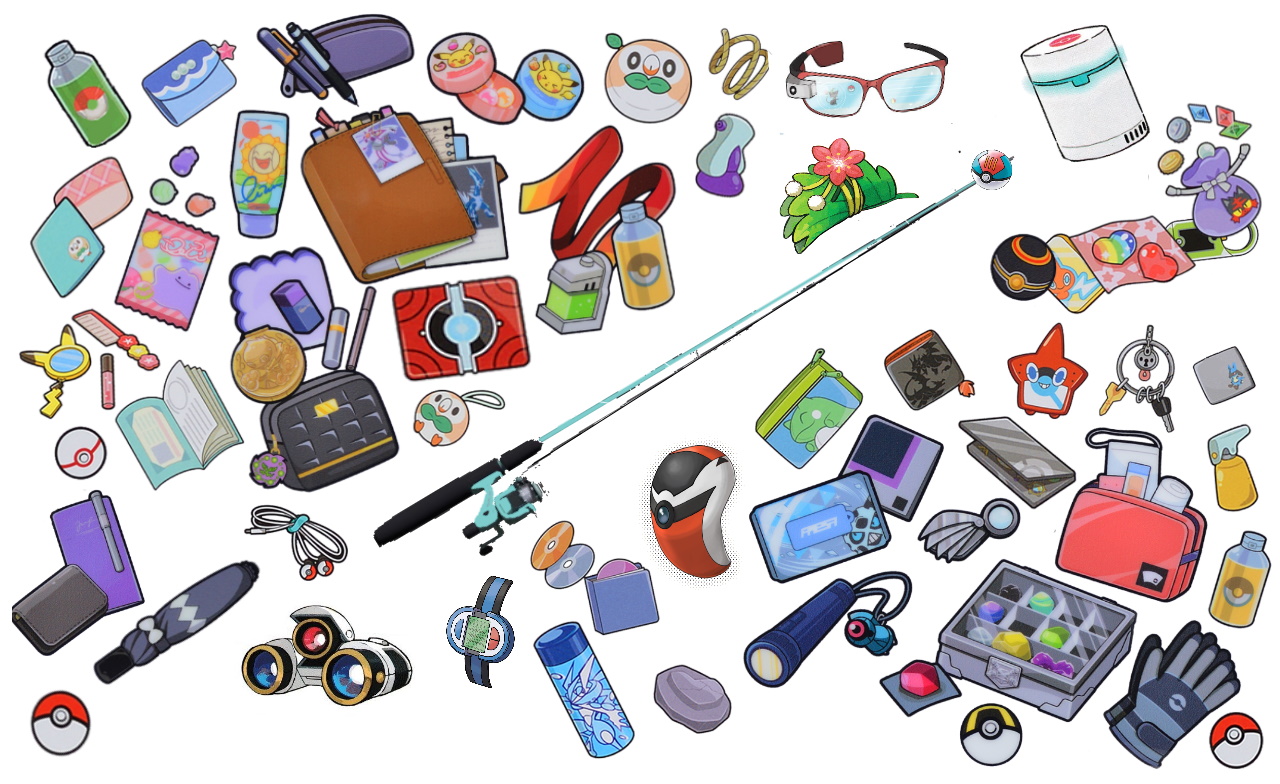


Inventory is a collection of gear that you carry on your person. It is usually kept in a 'Bag', the video game series' catchall name for a backpack, small duffle bag, sack, or even a briefcase used to store everything you need. You are free to design what your Bag looks like but all starting PokeBags are capable of holding the same Inventory. You receive the basic Pokemon Trainer Bag for free at the start of your journey. 

The world of Pokemon has a slightly unusual relationship with Time/Space and Mass, as evidenced by the fact that living creatures can be transformed into energy patterns that are then stored in balls about the size of Human fist. These very same spheres than shrink to roughly the size of a ping pong ball or golfball to be stored. Later, you can release the creature from the Pokeball with no harm to it at all (in fact, it might even be healed of earlier damage but we'll talk about that another time). 

Likewise, a Pokemon Trainer can keep items in their PokeBags that might not seem to fit, such a Med Kit, a Fishing Rod, and even a Bicycle. It's not about the weight or mass of the object - well, not exactly about that - but rather how many slots of available Inventory Space you have and how much each item occupies.


Each Item you wish to carry takes up 1 or more Inventory Slots and your PokeBag begins with 9 Slots. Most Items are 1 Slot-to-1 Item such as PokeScope Binoculars, a Pokedex, Rope, A Notebook (though Pens, Pencils, Post-Its, and other such things are included in the Notebook Slot), a Medical Kit (1 week of Medical Supplies), and Food Packs (1 week of Food, three meals a day plus snacks for 5 days). 

Items that take up more than one Slot would be a Portable Lab (2 Slots), Film Equipment (2), a Bicycle (2), or an Inflatable Raft (with two collapsible oars) (2). Larger Items would have to be discussed with the GM. 

In some cases multiple versions of the same Items can be held in one Slot. A single Inventory Slot can hold 5 Potions.

One slot can hold 10 Pokeballs, with or without Pokemon in them, but there is a catch. Six of these are considered 'Active', as Pokemon League law states that a Trainer may only keep six Active Pokemon on them at any time. These six can also be worn on your PC's belt, leaving room for extra empty Pokeballs in your Inventory. 

Your four remaining Pokemon are in a deeper storage slot - sometimes called 'The Box' - that is not easily accessible. In order to access your Box, you would need to stop and exchange one or more of your Stored Pokemon for your Active ones. Once switched, you must still end up with six Active and four Stored.

Example: Grete, a Pokemon Fisherwoman, has 6 Active Pokemon, three on her belt and three on her hat, along with a selection of lures. Generally these are there to help her with particularly tough Fish Pokemon or scare off local Pokemon Predators or Scavengers trying to steal her catch. In Grete's PokeBag, which resembles a Tackle Box, she has six empty Pokeballs and four Stored Pokemon. 

One day while fishing for the hard to locate Relicanth, Grete accidentally catches a Sharpedo who is none too happy to be on her line. During the fierce battle that immediately ensued between the Shark Pokemon and Grete's Yamper and Dragonair, Grete reached for an empty Pokemon in her Inventory and once weakened, she caught the ornery Sharpedo! 

But now...hmmm...she placed the Pokeball with Sharpedo on her belt alongside those containing Yamper and Dragonair. She now has too many Active Pokemon and decides to place her old friend Wartortle, usually the third on her belt, into Storage. She's relied on him a lot in past months and it might be a good idea to give him a break. 

Grete ends the encounter with six Active Pokemon (one of which is Sharpedo), five empty Pokeballs, and five Stored Pokemon. 

Your Money, also called Pokemon Dollars or Pokedollars, is also a part of your Inventory but takes up no Slot. It is stored in a separate compartment or perhaps in a wallet in your pocket or a side pouch of the PokeBag. 

OK, at this point the game needs lists of things like the above - Trainer Moves and Items - before one can truly finish creating a Character but I think there is enough to at least have a working concept. You could certainly put a PC together sufficient to run a Session Zero or Prologue type scenario. 

More to come with Pokemon AD and Rise and Fall as well as a lot of other things. I choose you!...to come back and check it out. Heh.

AD
Barking Alien


Friday, December 30, 2022

A Dungeon Challenge for the Dungeon Challenged?

These past couple of years I've done the 31 Days / 31 Characters Challenge wherein I have posted a different PC or NPC, mine or someone else's, from the plethora of past campaigns, short series, and one-shots I've run or played over the past 45 years. I intended to do that again this year when I can across...the Dungeon 23 Challenge.

The idea behind the Dungeon 23 Challenge is simple: Each day of 2023, create a single room in a roleplaying game Dungeon. At the end of each month you'll have a Dungeon Level. At the end of the year you'll find yourself with a 365 room MegaDungeon that's 12 levels deep.

Sounds fun. And yet...


Dungeon Map from 'The Cursed Fane'
A Scenario for the Japanese Fantasy RPG
Double Moon.

Fan Translated by Claytonian JP


OK, I get that a 'Dungeon' for an RPG can basically be anything. I could do an abandoned castle with levels going up. I could make a Cyberpunk arcology complex. The caverns deep within the mountains of an alien planet could be a Dungeon. These are relatively tame examples. You can really go wild!

That's not what's holding me back.

Most of these internet Gaming or Writing Challenges are a month long and are often hard to complete with my real life schedule. This is A YEAR LONG? Are you insane? I know myself well enough to know I won't get anywhere near completing this and I will berate myself for my perceived failure. 

No one's harder on me than I am. 

Additionally, what am I - and I mean I, Adam 'Barking Alien' Dickstein - going to do with a 365 room MegaDungeon even if I complete it? I rarely use 'Dungeons', mixing indoor and outdoor terrains and events almost equally, often having the two intermingle in a single scenario.


Isometric Dungeon Layout from
'The Adventurer's Bible' Delicious in Dungeon World Guide
By Ryoko Kui

English Translation by Taylor Engel, Yen Press


When I do run an adventure inside a derelict starship or a Supervillain hideout it rarely lasts more than one or two sessions. I don't want to stay in any one place that long unless there is a REALLY good reason to do so. 

The biggest and best reason would be because my players want to but that is almost never the case. Those who game with me know I have a billion different environments to show them and they want to see them. Why hang out in a given location past having anything important to do there? Head onward to a brand new land and if we ever want to revisit the previous place, well, we will.*

Bottom line, why join a 365 day long challenge I am highly unlikely to be able to finish, whose purpose is to create a MegaDungeon I am very unlikely to use?

Hmmm. OK, hear me out on this...

What if I reduce it to one entry a week? A room every Friday. That would result in 52 entries in 2023. If it were still something with twelve levels that would mean only four or five rooms per level so I'd have to consider adjusting that. It might depend on what the 'Dungeon' is. It's also possible...ooh...let's say I am only detailing the rooms with some game relevant element.


Scenario Map of 'The Moonlit Manse'
A Scenario for the Japanese Horror RPG Ghost Hunter

By Gou Shirokawa, Fan Translated by Claytonian JP


Yeah...If there are five other rooms on the same level with nothing unusual in them they might not need their own entry. If it were living quarters for a castle guardsman I could say, "There are six rooms on this level that serve as the sleeping quarters for the castle guard. Each room holds the bunks for four Human sized individuals. Aside from minor personal items, which are few and far between, the rooms are essentially identical. That is, except for the third room as you walk down the hall from West to East. In the third barrack, Room #XX, there is..." and explain how it is different, interesting, and significant. 

Now, if I made the location the base of operations for the PCs in one of my games such as a space vessel, a seafaring galley, an orbital research station, a haunted house, or whathaveyou, I'd be making up a location I would also be using. Even if it weren't their headquarters, if it was something they were exploring each week, the creation would serve a purpose in real time as well as fulfilling the challenge. I love that. 

This is starting to sound really interesting and its giving me other ideas. Things are looking good going into 2023.

Stay tuned!

AD
Barking Alien

*One of the things about Modern and Future Era RPGs is that transportation is fast and safe relative to Fantasy. Cars, trains, planes, grav vehicles, starships, and even personal flight as a superpower makes it so travel to and from great distances is pretty easy. Not only does this allow you to be in a steamy jungle in one session and an arctic tundra the next (or even later on in the same session) but going back to a locale you've already been to is not big deal.

In Fantasy it takes so long to go to most places it feels like a huge undertaking to travel back 'home' and so the hobo portion of murderhobos is born. I suppose you could always mass teleport whole armies across the world like in Games of Thrones or Rings of Power but...ugh.

Another interesting note before I go...I wanted to use Dungeon Maps from Japanese Tabletop RPGs for the illustrations here because I'm on a JTRPG kick again lately. It was so hard finding any it was astounding. I couldn't find a single one in my own collection outside of the Delicious in Dungeon image above. The rest, small and kind of unimpressive as they are, are thanks to Claytonian JP, a real guru if you are interested in learning about the Japanese TRPG scene. You can find him on Twitter here. Great stuff! 

I guess the Japanese use Dungeon Maps about as often as I do. We have so much in common. ;)


Thursday, December 29, 2022

The Pokemon Trainer Afraid of Asking is Ashamed of Learning

Before I go on to explain the last two elements of the Character Sheet, I want to talk about a change to one of my previous rules. That's right, this is a work in progress and when something can be improved I am more than willing to improve it.


One of my players for this campaign noted that left over Story Points from each session becoming Game Points, especially XP to improve your character, might not be the best way to go. It could result in players hoarding Story Points and not using them as is the intention so they can spend them later on for upgrades. Also, if some players do this and others don't it may result in very uneven character progression. I concur, although I can't see any of these guys doing this I am putting on the internet for anyone to use and yeah, some gamers are going to abuse this.

Instead, I am going to go with what my friends and I call 'Milestone Improvement'.

"Take loses and wins with the same attitude as they are both part of life."
-Danish Proverb

Player Characters still begin every session with a single, 1, Story Point. There is no change to how it is obtained or spent (more on that in a later post). The difference is that at the end of each session, all unspent Story Points are lost (so use'em!). 

In order to improve your character, your PC must reach some sort of Milestone; the character must achieve or best an objective or goal set by the Player themselves and/or the GM. For each Milestone successfully reached, the PC receives either: 

  • A New Trainer Move
  • A Skill Die or a New Skill
  • An Additional Personal Attribute Die
  • An Additional Trainer Attribute Die*
  • An Increase to your Trainer Class Skill*

* I am not sure if Exploding Dice shouldn't cost more. Two Milestones? Bigger Milestones? Hmm. Some of the Milestones would be the culmination of short term goals or the completion of single 'adventure'. Completing a story arc, a series of related adventures that ends in a big reveal and/or a major boss battle, should be a more of a major milestone. It's like finishing a Game Level in a Pokemon Video Game (before moving on to a new section of the Region).

I also recommend, if at all possible, that the upgrade to the PC be related to either the skills and abilities they used or to the Milestone they reached. At least remotely. 

Example: Ben, a Pokemon Rider, has the long term goal of proving to his father that Pokemon Riding is a worthwhile career. At present, he and his friends are trying to rescue Professor Grayleaf, who has been buried under the snow of an avalanche! His companion Nina calls on her Diglett (Regional Variant!) and has it use Dig to the Professor. Once they do, their other friend William commands his Vulpix to use Blaze to thaw Prof. Grayleaf out! Still, she is in very bad shape and the nearest doctor is a good distance away over difficult terrain now covered in several feet of ice and snow.

Ben releases his Stantler (Regional Variant), his companions help him tie the injured Professor Grayleaf to him, and then he uses his Trainer Class Skill Riding to get the Professor to the medical attention she needs. The brave and clever rescue is all over the local news, which quickly spreads across the Alfmork Region. Ben receives a call from his father who says he is very impressed with Ben's Riding ability. Furthermore, while he's still not sold on Riding as a career, Ben's dad is extremely proud of him.

Ben gets a two upgrades, one for the Rescue and one for getting closer to his father's acceptance of Pokemon Riding. Ben's player can spend one to improve the PC's Fitness and another to add a new Trainer Move. He could also spend both to add a die to Ben's Riding Skill. 

This is the general gist of the idea. As with other elements of the game it may need a little tweaking but I'm pretty happy with it. Like some other factors, a more concrete list of which Milestones result in what upgrades or how many might need to be made but for now this is a good enough system to allow me to press on and complete the Character Creation process.

Thanks for listening and see you soon,

AD
Barking Alien


Tuesday, December 27, 2022

What Would It Take?

I had a wonderful holiday weekend, spending quality time with my Mom (eating The BEST Dim Sum in all of New York's Chinatown) and got to see some of my old Art & Design High School buddies (whom long time readers of the blog will know from many of my Champions, Ghostbusters, and Star Trek posts).

Not only that but I found out I somehow missed an announcement I've literally been checking for every week for a while now...my favorite Manga, Dungeon Meshi, is finally going to be made into an Anime series and by none other than the amazing Studio Trigger! 

DUNGEON MESHI (aka Delicious in Dungeon)
The Animated Series!

Woohoo!

This news, combined with a conversation with my friend David, and some thoughts I have and initially ignored last week have lead me to ask myself a question...

What would it take for me to run a Medieval Fantasy game for my Sunday group?

No, no, I'm feeling fine. Thank you for your concern. No, I haven't been replaced by a Parallel Earth Doppleganger or been infected with Mind Control Parasites. I'm just wondering and asking a question here. What would I need to do and/or have in order to run a game of Dungeons and Dragons-esque Fantasy on a weekly basis for three players? 

It is quite the quandary. 

It's no secret that the Fantasy genre, especially of a D&D bent, is not really my thing. I actively dislike the kind of RPGs that are usually used to portray the genre as well; clunky things with Classes, Levels, and lots of crunch that rarely fits the setting and takes away any sense or feeling of magic. Still...

What if it wasn't like that? What if I ran a different sort of Medieval Fantasy with a different set of rules? Now I've technically already done that with my homebrew world of Aerth and The Order of The Winghorn Guard. There I am usually running a Fantasy game with the structure of a Superhero RPG, just applied to a High Fantasy setting. Here I want to run something more 'traditional'. Kinda. Sort of.

The conundrum in this instance could be looked at as, "How can I come as close as possible to running D&D, while making sure I am absolutely not running D&D?" Like a Medieval Fantasy RPG game of Blackjack. Somehow I need to get as close as I can to 21 without going over. 

So what is it I want and need? Hmmm... 

  • A Medieval Fantasy world that feels like it takes place in another place and time. 
  • I need an Open World where the players/PCs can go where they want and do what they want.
  • At the same time, I need people for them to meet, things for them to do, monsters for them to slay, etc. These guys don't self-motivate that often. 
  • Player Characters should each has their own specialty but also everyone should have the basic skills needed to be Medieval Fantasy adventurers.*
  • I want an interesting Magic System. Magic should be uncommon, powerful, dangerous, but also cinematic in an Anime/Manga sort of way. 
  • I need scary, mythic/folklore monsters, not piles of hit points and predictable abilities.**
  • I want dungeons but only if I can do something really interesting and different with them
  • I'd like day-in-the-life moments where not every second is an 'adventure'. 
  • I'd also like fast paced, exciting, dynamic, kinetic, and possibly brutal, in-your-face combat; not a take-our-time, large scale military tactical approach to a small group suddenly fighting another small group. That never made sense or felt right to me.***

*I've discussed this before. The idea is that every D&D character should start out as an 'Adventurer', a kind of Fighter/Thief hybrid. That way they have the basic skills needed to be a D&D character. Add any additional, more specialized skills or talents on top of that.

**This shouldn't be difficult. My monsters rarely feel like traditional Fantasy RPG monsters.

***As The Real John Wick recently noted in one of his Youtube videoes (paraphrasing), 'It feels like the people who design most RPG combat rules have never actually been in a fight.'

Inspired by my good friend Tim Knight from Heropress who was in turn inspired by me...so...inspired by myself?, here is my 'Inspiration Board' for this campaign at this time...


Although a bit of Mörk Borg and Elden Ring are creeping in at the corners of my mind's eye.

I am sure there is a lot more I could add but these are my initial thoughts. That thing is, so far I've searched around quite a bit and I have a 45 year history in the hobby. No game seems to exist in the Medieval Fantasy genre that does what I want in the want that I want it except for Ars Magica and I am trying to run something different from that, something new (new to me or to the group).

Comments and thoughts are always welcome.

AD
Barking Alien


Sunday, December 25, 2022

A Headstrong Pokemon Trainer and A Fool May Wear The Same Cap

First a little housekeeping...

Happy Holidays and Merry Christmas!

It's nearly the end of 2022 and while it was a good year for me in my non-gaming life, my 45th Anniversary in the RPG Hobby was a whole lot of disappointment. All my plans for the blog were for naught as none of my thoughts and ideas amounted to much of anything. Ugh. Total waste of 12 months.

In addition, I got frustrated and burned out with my gaming to the point where I not only couldn't be motivated to blog, I wasn't motivated to run or play after while. I have spent the past month and change not gaming but searching for a way out of my funk.

Luckily I have in the form of my planned weekly Pokemon homebrew RPG campaign set to start in January. This still leaves me needing a campaign for my Sunday group and ideas for my bi-weekly return to Star Trek Adventures. I have some thoughts and even prospects on those fronts and I'll be discussing that in some upcoming posts. Fingers crossed.

Before that, I want to finish the Character Creation rules for Pokemon: Rise and Fall. I am getting some good feedback on the material so far and my players are pretty excited. I want to apologize for the slightly disorganized nature of the Character Creation explanation. Although I am trying to be organized, my enthusiasm and excitement for particular elements are making the posts feel a little more stream of consciousness than I'd like. I hope its working for everyone. Let me know in the comments. 

Now, back to Pokemon AD!


Taking a look at the left side of the Character Sheet, below the Character's basic information and just to the left of one's Skills, we have Stamina, Stress, Story Points, Advantage, Flaw, and Enemy/Rival. Let's break it down...

Stamina is a measure of a person's health, well-being, and ability to keep going without passing out. Instead of Hit Points, a Pokemon Trainer takes physical damage to Stamina as well. When you do battle with your Pokemon, swim a great distance, climb a mountain, or fall from a considerable height, you lose Stamina.

Stress is similar but mental. When your PC gets frightened, confused, extremely frustrated, or faces off against psychic powers, you lose Stress

Player Characters begin the game with 10 points of Stamina + 1 for every die in Fitness.
They begin with 10 points of Stress + 1 for every die in Drive.

When something threatens to harm or wear down your PC, from weather conditions to Pokemon attacks, they lose Stress equal to the Attack Move or Hazard's Damage Rating +1 for every Success that exceeded your Trainer's attempt to Avoid Damage. There are numerous ways to Avoid Damage, from simply dodging to having a Pokemon Defend for Counterattack for you.

It is the same for Stress, though there it can get a little more Narrative Driven, with the context of the situation and other factors potentially playing a larger part in modifying your Avoid Stress rolls.

There will be more about this when I cover the Basic Rule Mechanics in the near future. 

Note that allowing yourself to be Injured, Worn Out, or Stressed can earn you a Story Point. Which brings us to...


Pokemon: Rise and Fall Pokemon Trainers
Art by Midjourney, modified in Arcsoft Photostudio by me.


Story Points are points the Player can spend to manipulate the outcome of a situation, essentially giving them active agency over the story (the events in them game). Story Points can be used in a variety of ways, from doing extra damage to creating an opportunity that will enable the PC and their allies to escape a tough predicament. 

Before discussing what they can do, let's talking about how you get them. 

Each PC starts every session/episode of the campaign with 1 Story Point. Unused Story Points left over from previous episodes become 'Game Points' that are used to improve the Pokemon Trainer and in some cases their Pokemon. Game Points are usually recorded like this:


Example: Tom's Pokemon Trainer PC - Milas - is beginning his fourth session of a Pokemon AD campaign. As noted above, he starts the game with 1 Story Point, as he does every session.

In his first session he used all his Story Points and had none left over at the end. In his second session, Milas ended the game with 3 unspent Story Points. Those became Game Points. In session three, the game ended with Milas having 2 unspent points. Those were added to his Game Point total.

Now back to where we started, Milas begins session four with 1 Story Point and he has 5 Game Points saved up for Tom to improve his character. 

During a session a PC may be awarded a Story Point for a variety of reasons connected to their Trainer Class, established nature, and the themes of the Pokemon world. As examples, a PC would get a Story Point:

  • If a Photographer braves rough terrain to get a difficult shot.
  • If a Professor discovers a heretofore unknown Pokemon.
  • If someone is damaging the nature habit of local Pokemon and you stop them.
  • If you come up with alternatives to damaging the ecology, especially if it requires people and Pokemon work together! That's definitely worth 2.
  • If you go to help an injured or trapped Pokemon.
  • If you let a Villain escape in order to help and injured or trapped Pokemon you get 2!*
  • If you let yourself get captured or imprisoned!
  • If you play up your Flaw. 
  • If you prevent a Villain from stealing someone else's Pokemon.

*If you don't go after a villain in order to help an injured Pokemon but one of your companions does, you only get 1 Story Point.

These are by no means all the ways to get a Story Point but you get the gist. The key is to make a choice and take an action that will further the story, embrace the setting, be exciting, and in the end, memorable. 

I think I may do a big future post expanding on the Story Points future.  

Next up we have Advantage; an Advantage is some sort of condition or aspect of your character that gives you a benefit in a given situation. Possibly many situations as a matter of fact. Advantages are things such as a Contacts, Excellent Hearing or Vision, Wealth, or the very popular 'Signature Pokemon'.

A Signature Pokemon is on such good terms with its Trainer that it doesn't travel around in a Pokeball and often can communicate with them nearly on the level of being another member of the team. Ash's Pikachu is the quintessential example of this. Pikachu is pretty much a person in his ability to understand Humans and can carry out actions more like a standard NPC as opposed to a Pokemon (though still within the limits of his form). 

Players and Gamemasters should work together to create Advantages that work for the campaign they are creating. The key components of a good Advantage if that it is useful (a useless Advantage is not an Advantage), applies often but not always (see below), and is somewhat imperfect or comes with a limitation.

Example: Your PC might come from a minor noble family and be Wealthy but too many extravagant purchases might have your parents calling to see what you're up to. They might decide to limit your spending! Gads, the embarrassment! 

The one exception is the Advantage 'Psychic Powers'. I will do a separate post regarding Psychic Powers but they are something that is useful, pretty much always applicable, but yes they are limited and/or imperfect (until you learn to master them). 

Flaw is the opposite of Advantage and really helps define your Pokemon Trainer. The bigger the Flaw, the more likely playing it up will gain you Story Points. Be careful not to make it so big or so commonly occurring that your character is inept and unable to go on adventures with your companions.

As a side note, a lot of gamers I know have a lot of difficulty creating Flaws for their PCs across various games. Their Flaws or disadvantages are either not hindering at all (my Character is Overconfident because he's too Awesome. No, it doesn't really effect play.) or they shoot themselves in the foot with machines guns (My Character is terrified of his own shadow that I'm going to spend 30-45 minutes of game trying to figure how to help the party without revealing my presence to the NPCs with every action I take). Try to find a mid-ground. 

Some good Flaws might be Can't Swim, Emophilia (Falls in love easily like Brock), Fear of Ghosts/Ghost Pokemon, Naive/Too Trusting, or Poor.

Finally we come to Enemy/Rival. Ideally a Rival should appear by the first full 'episode' (i.e. they show up in either the Tutorial session or first regular session), while an Enemy will often be determined at the end of a story arc or adventure (regardless of the number of sessions that takes).

A Rival is someone with whom the PC has a competitive relationship, though it need not be hostile in nature. It could be someone who wants the same thing as the PC, to be the best in their shared Trainer Class, or even a Rival for someone else's affections. Remember that competing with the Player Character and getting them to try harder and be better is the purpose of the Rival, not to harm or hurt the PC. 

An Enemy is quite different and is a threat to the Player Character, their companions, and/or their goals. They may not mean to physically hurt the PC but the objectives of the Enemy directly oppose those of the Player Character and their friends. An Enemy might try to steal the PC's Pokemon, kidnap and imprison the PC to prevent them from thwarting the Enemy's plans, or do battle with them to ensure an outcome favorable to the Enemy.

In choosing a Game Version - in this case Pokemon: Rise or Pokemon Fall - the PCs also determine their default Villain Organization and therefore their Enemy. Well...sort of.

It is completely understandable that a PC may choose someone other than the associated Villain Team to their Enemy. Perhaps they choose a particular Lieutenant of the organization or an individual Mad Scientist working with them. Perhaps there's an antagonist that is both the PC's Enemy and no friend of the villains. Either way, the Villain Organization connected to your Game Version will definitely be a foil for your PC whether or not the character acknowledges them as their main adversary.

Whew. OK, going to break here. See you soon!

Merry Christmas and Happy Holidays to All! Peace and Love Everybody!

AD
Barking Alien