Showing posts with label Rules Lite. Show all posts

Saturday, July 25, 2026

HEROES IN SPAAACE!

What's up next on the Barking Alien agenda Adam?

I'll take 'Obscure 'Old School' Japanese Science Fiction Tabletop RPGs' for the win, Jack!

You got it...


Space Opera Heroes

Written by Atsushi Yamakita
Produced by Far East Amusement Research - F.E.A.R.
Published by Hobby Japan, 1992


I can't even tell you how many times I've come across physical copies of this game and not purchased it over the years. So. Many. Times.

It was, quite literally, the Japanese TRPG I would see most often, on a regular basis really, in Books Kinokuniya, Asahiya Books (no longer around), and my very first love, Zen Oriental Books (also long gone). I never picked it up because...well there was always a reason. 

  • I don't have the money right now.
  • I can't read Japanese (like that stopped me before or since - lame excuse!).
  • I'll get it next time. They always have a copy.
  • This other one is rarer/cooler/less expensive.
  • It doesn't look all that great. 

I even remember a Japanese friend telling me it was nothing special and that no one into gaming in Japan talks about it. It only had one supplement put out for it. Maybe my friend was right. Maybe it wasn't so great. And so little support? How popular could it have been? All that said...it always nagged at me. I had to get it and sure enough once I decided to...it was no where to be found. 


Space Opera Heroes 2
A Supplement of Additional Rules, Options, and Ideas. 


Fast forward to last week when I was doing some JTRPG research and I just happen to come across a reference to Space Opera Heroes purely by chance. I copied and pasted the Kanji and did a search to see if I could find any more about this 34 year old year that hardly gets a mention these days. What did I find? Apparently, the original author of the game wrote a sequel of sorts in 1998 titled 'Star Road' and when he did, he put the entire first edition rulebook online...for FREE! 


Star Road
A 1998 Sequel to Space Opera Heroes

Written by Atsushi Yamakita
Produced by Far East Amusement Research - F.E.A.R.
Published by Gamer Field


Needless to say, I've been downloading and translating the book and WOW, was everyone wrong about this thing. It's low key awesome! It features a number of interesting ideas that are kind of unusual for games of that period in both the Japanese and the US market.

Space Opera Heroes Features Include:

  • Characters can be built quickly using one of 40+ Archetypes!
  • It's rules-lite, with a simple Stat+Skill+1D6 vs. a Target Number base mechanic.
  • PCs can use Hero Points to achieve various special actions or effects.
  • There are NHP - Negative Hero Points for the Space Opera Master!
  • The Heroes (PCs) can't die unless the player wants to allow for that. Wha?!?
  • Missions are always successful but there can be serious consequences. 
  • Classic Space Opera tropes are not just encouraged but enforced.
  • There is a recommended adventure structure to keep things feeling Space Opera. 

These are just some of the cool concepts in the game. I am still going through the rules of course but I keep finding more and more intriguing bits. 

A few things I would change: Starships are mentioned throughout but the rules for them are almost non-existant. That is to say, they don't have a system for making spacecraft, what to do with them beyond fighting, etc. The game essentially treats starships as items your character owns, no different from a Laser Pistol or Ray Sword (an alternative name for Lightsaber that I must say I really like). I would probably incorporate the rules from Space Ship Story into the game to expand the starship into a character and a useful base (and you know how much I love bases). 

Another thing is Aliens; the attitude the game takes towards aliens is novel but not one that particularly appeals to me. It implies that while there are primitive forms of alien life and ancient civilizations with relics to be found, there are no active Alien Intelligences in the setting until a PC makes first contact with one. 

I get this and it is reminiscent of a certain type of Science Fiction from the same era as Space Opera's Golden Age. At the same time, E. E. Smith's Lensman series, identified as a major inspiration for this game, was chock ful of sapient aliens! Looking at the game's 'Appendix N' you've got Captain Future, Captain Harlock, Heinlein's Citizen of the Galaxy, Larry Niven's Known Space books, Star Trek, Star Wars, and many others that feature aliens as regularly interacting with the Humans of Space. 

Granted, I think what the game was going for is something more in the vein of Crusher Joe, The Dirty Pair, Season 1 Space: 1999, and other more Humancentric settings. Thing is, I love Space Opera and only tolerate Humans so I'd likely make alien Archetypes or a single, flexible Archetype called Alien. After all, there are Optional Rules for Robot Archetypes that range from a Humanoid Robot to a powerful Combat Robot to a Replicant/Bioroid type. Why not an Alien?

I did not expect to write about this game tonight, let alone write this much on the subject.

Smurfs, Open World Exploration, and more Space Opera Heroes to come real soon,


Good night Space Cowboy!

AD
Barking Alien


Saturday, September 27, 2025

The Bright Side of Light Games

JB, Wizard King of Curmudgeons, made a post on his blog B//X BLACKRAZOR wherein he speaks extensively (and then some!) about the 'wrong-bad'TM evils of 'Light Games'.

I recommend going over there and reading it, though be aware it might take some time to do so, perhaps even multiple sittings.  

The post gave me the idea to write one of my own about how awesome Light Games can be, as many of my current favorites fall into that category.

To be clear, this isn't a 'Point-Counterpoint' response and I don't intend to get into a debate with JB. His reasoning and opinions are his own and needn't be argued with by the likes of me. He is a very particular fellow with a very particular view of a very particular game.

I don't like that game. I don't enjoy playing or running it. I would much rather spend my limited free time with the great many games I do enjoy and, as stated, a lot of these would be considered 'Light Games'. 

Now, Light Games is not a term I think I've heard or seen very often, so you'll see me interchange it here with the term I'm more accustomed to, 'Rules Lite'. Also, I will be addressing the subject in very general terms, mentioning specific TRPGs as examples or points of reference when and where it's useful. 

Take it Light


Let's get the obvious and expected reasons for liking Rules Lite games out of the way first; Simpler rules and fewer of them means the game is easier to learn, explain, prep for, run, and play. In addition, play is usually faster as everything from Character Creation, to Combat, Task Resolution, and Experience/Character Improvement has less complexity to it. 

As we get older we have more responsibilities and less free time. Assuming the average adult TRPG enthusiast has maybe 24 free hours of leisure time and only 4 or 5 of those alloted to actually playing their game of choice, do you want to spend that time agonizing over mechanics and looking up rules in your preferred corebook during a session or would you rather use that time to do research, find cool images, and then hit the ground running and proceed at a smooth, exciting pace?  

I'm sure for some the answer is, "I like worrying about all 6 PC's Encumbrance Initiative Modifier! Give me so much crunch my breakfast cereal is gravel!" Well OK then, go for it! Knock yourself out. For the rest of us, we want to get to the part where we explore the game world and defeat monsters. We'll be doing just that while you're still looking up the Movement Rules by Terrain and Weather in Chapter 25.B. 

A Little Light Reading

In the time it takes to learn, let alone master, some of the more crunchy, complex TRPGs, one could get a working knowledge of a half dozen Rules Lite games. This allows you and your group to sample a variety of different approaches to mechanics, genres, and settings. One of the big hurdles I heard about when trying to get gamers to try a new games is they don't want to take the time to learn a whole new set of rules. That makes sense if you are only familiar with rules that take a long time to learn. 

Learning 6 Rules Lite games in the time it takes to learn one Rules Heavy one may sound like an exaggeration but consider my own experience and obession passionate interest in Japanese Tabletop Roleplaying Games.

It took me less time to fully translate and understand Meteor City-Star Rainy Days, Tokyo Ghost Research, and the recently obtained Zookyo Island (basically a Crime Drama/Thriller take on Disney's Zootopia) then it did to get a handle on the Cypher System. Cypher isn't super Rules Heavy per say but compared to the the games I mentioned above, it feels almost cumbersome.

I've said many times in the past that my feeling is most RPGs are 20-30 page workable games buried under 300+ pages of overthinking and unnecessary junk. Sometimes you'll find a game where those 30 pages are more than workable; they're downright good! Maybe really good! It's also possible some of those 300+ extra pages contain some interesting and useful stuff. It just like game designers over design and over write the majority of games on the market.

Cypher comes in at 450 pages [for the PDF]. Meteor City is 58 pages, Tokyo Ghost Research is just 28 pages, and Zookyo Island is 40 pages respectively. That makes those three games together 324 pages less than Cypher. See what I mean? Much easier to read through all of those in less than half the time it would take to read the core Cypher rulebook. 

My point isn't 'Smaller is Better'. My point is simpler and less complex is easier to comprehend and explain to others. It's each to remember as well. If done well, it means a more direct design that gets to the crucial features quickly.

Light on My Feet

Another benefit related to the above is the ability to ad lib and improvise feels much easier in Rules Light games. There is less of a concern/fear that making a decision on the fly is going to have rippling ramifications that 'ruin the game' for everyone involved. 

Especially with games where the base Task Resolution mechanic is the same for virtually any and all actions, if you are unsure how to ajudicate something, default to that base mechanic. Easy peasy. And once again, since a mistake or bad call is unlikely to impact a dozen other sub-systems, if your judgement wasn't perfect you come up with something better for next time without much muss or fuss. 

In full transparency I just couldn't get into the Cypher System and complete acknowledge my difficulty in wrapping my head around it isn't due to its complexity but rather how the rules are explained and all the subsystem elements that I find don't gel with my gaming style. 

Light on Calories, Heavy on Flavor

I'm a tinkerer. It's who I am. I like to customize, modify, kitbash, and adjust things just so. 

It is much easier to change or even add rules to a Light Game. Too many houserules and adjustments to a Rules Heavy RPG can result in the whole thing collapsing around your ears. Rules Light games are far more forgiving in this regard. 

I remember my first [and arguably] most successful long term 'Well Known Fantasy RPG' campaign. Over the course of the 4 years or so that I ran it (which included playing it several hours each day, Monday through Friday, in the Summers) I made a lot of modifications and houserules. Each one was specificallydesigned to give the game, the world, and the characters a certain feel. Eventually, I looked at my book of notes on the game and wondered, 'Am I really even playing Well Known Fantasy RPG anymore? If not, why am I still using it at all? Why not find or make a game that does all these things I want to do?' 

I admit it was fun to customize Well Known Fantasy Game but in the end I switched to a simpler, less rigid, more flexible set of rules that suited the game I was running much better. 

***

I could go on and on with this subject (not unlike JB did with his post) but I have other projects going on I'd like to get to - many related to what would definitely be considered Light Games. I hope I gave you some idea of why I personally love Rules Lite games so much. Honestly some of my favorite RPGs right now are Rules Lite and I would rather run and/or play any of them a thousand times over than have to sit through one of the clunky, slow dinosaurs of gamings heyday. 

Yes, I do love Champions [4E], Yes, I love Traveller. Those are the exceptions though, not the rule. 

Sign me up for ALIEN, Footprints in the Night, Ghostbusters (Original, InSpectres, Mine), Meteor City - Star Rainy Days, Smurfs, Star Trek Adventures*, Super Happy Sentai Hour, Teenagers from Outer Space, Tokyo Ghost Research, Zookyo Island, and more...

Stay tuned and see what pops up next,

AD
Barking Alien

*Star Trek Adventures is arguably not Rules Lite but it is essentially a much less complex game than any of the previous versions of Star Trek. In addition, I find it really easy to run and to me it has the same feel as many of the Light Games I enjoy. 

I also ignore 30% of the mechanics. 

Bye now!


Saturday, February 4, 2023

BREAK!! On Through To The Other Side

Ten Years In The Making...
Is WAAAY Too Long!

But still...


For a long while now, nearly as long as I've had this blog, I've been aware of and interested in an RPG project called BREAK!! 

Well, it turns out a Kickstarter for the release of the BREAK!! rulebook is starting very soon and I'd be VERY surprised if this didn't get funded and freakin' quick! 

Created by author Reynaldo MadriƱan and artist 'Grey Wizard', BREAK!! is a Tabletop RPG inspired by Japanese Anime and Video Games that seems to have been in development for a least a decade. It uses multiple die type (Booo!) but mostly D20 and D12.


Characters are essentially defined by a Calling, an archetype not unlike a Template or Class in other RPGs but broader as I understand it. Each Calling gives the PC a framework or outline structure while also providing a wide array of options that enable the player to customize their characters. In addition, PCs have a Species, a Trait, a Quirk, Equipment, and all the things you'd expect to see in a 'Classic' or 'Old School' RPG. 

For the GM there is a ton of setting material, from locations and monsters, to magic and technology, and many other things with which to create adventures and campaigns. In addition, and most interesting to me, are guidelines you can use to create stuff all your own. Tools for adding my own components? I do love that. Remember that this is a game with Anime/Manga/Computer Games inspirations. In addition to Goblins, Wizards, and trap filled Dungeons, you'll also see Mecha, adorable Witches with Rocket-Powered Brooms, and bizarre terrain frozen in Day Time, Night Time, The Past, or The Future. 


This is a game I've been extremely curious about for, as noted above, an especially long time. I've checked back regularly, watched the YouTube videos on Character and Adversary Creation, and signed up for the mailing list. That last part is how I found out about the Kickstarter Pre-Launch and I have to admit, I was surprised. 

After so many years of following the project with no completion in sight, the idea that BREAK!! might actually come out wasn't something I consciously considered. The website was fun to check in with, the art is awesome and inspiring, but the thought, 'I can't wait until I can buy this!' hadn't seriously occurred to me since waaay before the height of the Pandemic. I viewed the game as something akin to actively developing vaporware. 

Now it might actual come out and I'm both excited and more than a little nervous. I don't need a Fantasy RPG but I do like the aesthetic and Anime/Video Game elements. I don't like Multiple Die Type systems (why do games I am initially excited about keep using all the dice?! So rude!) but I think I could mine the ideas in this for other systems, making it a fantastic resource.

All that aside, I want to see this! I really do. I just want to see what a decade of work on a single product can achieve. Having worked on pet projects of my own for decades, I know how difficult it can be to finally say you're done.

I am amazed not only by the effort and talent showcased here but seriously inspired by whomever said..."OK, it's finished."

I will be supporting this and I will keep you posted on how things go.


AD
Barking Alien


Thursday, September 1, 2022

RPGaDay Challenge 2022 - Bonus Round

The RPGaDay 2022 'Event' is over and underwhelming is an understatement. 

Six questions that amount to 'Tell me about your character'? Three on the RPGaDay Challenge itself, including the gripping philosophical conundrum 'When did you start participating in this'? Really? REALLY? C'mon, put a little effort into it or don't bother. 

With the whole RPGaDay 2022 being what it was, I am practically beside myself to post something for this bonus round...


As noted before, I don't like tagging people, so I won't be doing that. I really couldn't even if I did want to in the case of this story as none of the players were close friends of mine and I lost track of them all years ago. 

One Saturday when I was in my early 20s, must have been around 1990 or '91, I went to a 'local' RPG Convention in New Jersey. I met some great people, played some great games, and ended up having a conversation on game design, theory, and all the other big life questions with a bunch of people into the late hours. One or two were regular acquaintances, a couple were friends of friends, and a couple were people I'd met that day. One was a woman who...well...instant crush. 

Anyway, it got late, a lot later than intended and I was kind of dreading the long train ride into New York City. The nippy Autumn weather was no problem for me but it was drizzling and foggy. I considered calling up a friend who lived in Jersey to see if I could crash there when two of the people I'd been talking with said I could stay overnight in their hotel room if it was cool with the third occupant and I had no issues. It was all good and I slept there that night. 

Except I didn't sleep. None of us did. Intrigued by my ideas and approach to gaming from our earlier conversation, my three impromptu roommates wanted me to run them through a short, makeshift session of something. I said sure. Then one of them said, "Hey, we should see if we can get some of the others [from the earlier conversation group]."

Everyone nodded in agreement and so I said, "Sure. What the heck."

Sometime later, with coffee and snacks, we ended up in a room in the hotel probably used for meetings or as a lounge. I can't recall exactly. I just remember a big room, a couch, some chairs, and a coffee table. Some of use were in our clothes from the day before but I remember Crush Girl was in her PJs. 

Here's how the game went down...

Medieval Fantasy. A Dungeon Crawl That Wasn't. I had everybody take a piece of paper and told them to write down their Character's name, a nickname or title, their 'Race', and three things they were good at, one thing they weren't.

Their last task was to come up with a question they wanted to ask one of the other characters. When they were all finished with their PCs, they asked each other one question each. Some of the questions were like:

'How do we know each other?'
'How'd you get that title/nickname?'
'Do you have any hobbies?'
'What Monster scares the bejeezus out of you?'

Finally, I asked them all, 'Why are you doing this? Adventuring is a hard life. Dungeons are freakin' dangerous. Why risk it?' The answer to this formed the key elements that drove the adventure. To put it another way, I focused on their personal backstories and their interactions with each other with pit traps and goblin hoards being the framework and backdrop of the game, not the main event. 

It blew them away. Many were Anime fans and said it reminded them of their favorite Manga and animated series. It had humor but they also feared for their character's lives. I remember someone saying they cared more about their character here than in the home game they'd been playing in for months by that point. 

It felt great to get the praise of course but it was also just a really fun session. It lasted well into the morning and I ended up sleeping three hours and then going to the con for a second day. 

If there is any interest, I'll write up the characters as best I can recall them and even a little about the adventure. I'd forgotten about this game for years, decades honestly, only to have it come back to me in a recent conversation with a fellow online regarding great one-shots.
 

Art by Me by Midjourney


Thanks for checking out the post. Look around the blog and see if there's anything else that might interest you. 

Next month...we're going to SPACE...

AD
Barking Alien


Tuesday, March 1, 2022

Age of Resistance

The game company River Horse has published The Dark Crystal Adventure Game, a Tabletop Role Playing Game set on the World of Thra, the setting of the 1982 Fantasy film and 2019 Netflix series Age of Resistance. 

It just so happens that I've been working on a Dark Crystal RPG of my own for, oh I don't know, OVER 35 YEARS! Sorry, whew, deep breaths. In addition, I was almost part of the team that worked on a Dark Crystal RPG to be put out by Archaia Entertainment before that project fell through.

With a great many unrealized ideas for campaigns and adventures among the Gelflings, Podlings, urRu, and Skeksis, I was extremely excited for River Horse's game. Now that I have it...I have thoughts.


The Dark Crystal Adventure Game
Dust Jacket Front Cover


The Good

First and foremost, this book is very pretty. Aside from the beautiful art by such well-known and Dark Crystal-affiliated artists as Brian Froud and Iris Compiet, it is full of wonderful spot illustrations, maps (Holy Aughra! The maps! More about that below), and just a general design sensibility that is absolutely amazing. Well put together, well presented (for the most part), and definitely in the vein of The Dark Crystal's aesthetic (again, for the most part). 

The adventures are especially well crafted and that is coming from someone who generally dislikes pre-made adventures. I typically find the adventures made for most RPGs to be bland and impersonal, rarely all that engaging and never quite fitting the game I am running. I end up having to modify them so heavily the end result is less me using the supplied scenario as the supplied scenario adding some ideas to an original adventure of my own design. Here, the ideas and subject matter of the story plots are so good, I can see myself running them with only a few tweaks. Maybe a dozen or less. Hey, I still gotta be me. 

There is some material from the comics added in as well as new material that, well, I mostly really like. Some of the comic material doesn't feel quite right to me but a lot of the new species, creatures, and other bits feel perfectly at home on the world of Thra.


The Bad

OK, there is some elements of the game I found rather disappointing. Mainly, the rules; the system provided is fine, rules-lite, and definitely workable. It is also rather uninspired, uses all the types of dice that exist because they exist, and doesn't feel especially Dark Crystal-esque. There are not stats but there are Skills, which are basically like Stats, except they're not. They represent categories of ability, each coming with three Specializations. You choose two Skills that you have and one Specialization from each Skill. If you have the appropriate Skill for what you want to do you add +1 to your die roll to hit a target number. If you also have the right Specialization you get an additional +1 for a total of +2. That's it.

Meanwhile, the official Character Sheet in the corebook doesn't list the Skills at all. It has little symbols representing them next to black boxes listing the Specializations. I get the idea they were going for since symbols and sigils are big in The Dark Crystal but these aren't established emblems from the lore and aren't pointed out ahead of time so it just looks like the Skills are missing. Again, their not but it doesn't make for an immediate user-friendly experience. 

Also, as mentioned above, the game uses all the dice from D4 to D12 (I believe it leaves out the D20 but I forget) even though most everything you do requires a D6 roll. So, why not make it all D6? Given Thra's relationship to the number three (Three Suns, Three Moons, the Third Eye of Aughra), I would've thought increments of 3 and therefore a 6-Sided Die would have been more thematic, not to mention simpler. 

The Darkening

Aside from the peculiar Skill/Attribute depiction, odd character sheet, and the rather lackluster rules over all, the game is missing something I am not sure I can put my finger on. It is missing a 'Dark Crystal-ness'.

At the same time, the Adventures help offset this a lot. These scenarios are very good and definitely have the right feel. The game as a whole...I am not sure. It feels like not enough was done to make this a complete RPG, though it is difficult for me to pinpoint exactly why I have this impression. 


In the End, the Beginning

As I've said, I've been working on a homebrew Dark Crystal RPG for many years now. I will very likely continue my work on that game and if I do get to run a campaign on the World of Thra that's the system I would use. I will definitely pour through this book for inspiration and adventure ideas.

As for actually using The Dark Crystal Adventure Game as it is, I can't see myself doing that. There just isn't enough here in terms of setting specific mechanics to run a Dark Crystal TRPG campaign in my personal opinion. 

That is all for now. See you next Conjunction. 

AD
Barking Alien


Friday, December 31, 2021

I Feel So Funky

This will be the last post on my Ghostbusters RPG fan project for the remainder of the year.

Heheh. OK, I was being a little cheeky there but seriously folks, I am going to take a short break from discussing this game to work on a few other things related to my ideas for next year. My last post of 2021, which will come out later today, will go into a bit more detail about my plans for 2022.

For now, here is the other half of Combat; the opponent's half. How Ghosts battle Ghostbusters and a few other odds and ends...


A good deal of this was already covered in the previous post entitled Spates Catalog

To Review:

The two Attributes of a ghost are Ectoplasm and PKE. Ectoplasm functions as Hit Points or Bumps [for the Player Characters]. PKE serves as both a Defense Roll and as booster Action Dice to heighten a ghost's Supernatural Abilities.

When a ghost is blasted by the Particle Stream from a Neutrona Wand, the Ghostbuster weakens the entity causing it damage with a Blast Stream or try to capture it with a Capture Stream.

When a Ghostbuster uses a Blast Stream, roll your to hit with the appropriate Action Dice, adding one Die for a standard Proton Pack. The ghost rolls its PKE. If the Ghostbuster gets 1 more Success than the ghost you subtract 1 Ectoplasm from the ghost for that first Success. With additional Successes beyond the first, the PC can opt to cause more Ectoplasm Damage or PKE Damage.

A ghost with Zero Ectoplasm dissipates, its PKE scattered and its connection to our world temporarily severed. It has not been eliminated however. It can't be in a traditional sense. Instead, it will eventually reform and return to its previous activities in a matter of days, weeks, months, or even years (depending upon the nature of the ghost). The more powerful the entity, the longer it takes to manifest again as doing so requires the gathering of a greater amount of Psychokinetic Energy. With some deity-level beings it can also take specific conditions that can be helped along or hindered by actions taken by its followers or enemies in our world.

SPOILERS: See Gozer the Gozerian and what was needed to summon and drive it away in both Ghostbusters (1984) and Ghostbusters: Afterlife.

A ghost with Zero PKE can not boost its Supernatural Abilities but more importantly has no Defense Roll to resist damage or capture. When you fire a Capture Stream, you roll your Proton Pack attack against the ghost's PKE. If you get more Successes than the ghost in this case, you 'lasso' it and another PC can go for a Blast, another Capture, or even drop a Ghost Trap. PKE is the ghost's power and it must be lowered to make capture possible. As long as the entity has PKE it can be rolled to resist things such as a Capture Stream or a Ghost Trap.

To capture a ghost in a Ghost Trap, the Ghostbusters must get twice as many Successes as the ghost does. If a Class V Free-Roaming Mist rolls 3 Successes, the PCs need 6 - 3 to counter the ghost's 3 and then 3 more to bag that sucker. This is why multiple Ghostbusters with multiple Capture Streams are helpful. You keep lowering the ghost's PKE and getting more Successes than it does making things a lot easier. 


A ghost attacks by rolling its appropriate Supernatural Ability and getting more Successes than the target's Defense Successes (usually using Athletics or Technology as noted in the previous post). 

The ghost may spend PKE to add Action Dice to its roll. This lowers their total PKE however. At the start of the following round (Rounds explained -sort of- below) the ghost automatically gets 1 PKE back. Now here's the new bit...heheheh.

Along with their Action Dice, Player Characters roll Stress Dice if they have Stress on their character from getting spooked, almost being blasted off a roof, being on fire, etc. Action Dice are 6-Sided Dice where a '6' is a Success. Stress Dice are 6-Sided Dice where the '6' is a Success and a '1' is Panic. See Listen...Do You Smell Something? . I use Stress Dice where the 1 is a Ghostbusters logo / 'No Ghost' symbol.  

For Ghosts All Dice Are Stress Dice. That is, their version of Action Dice are the dice with the No Ghost symbol. Typically referred to as Ghost Dice, a 6 is a Success and a 1 gains them back 1 Die of PKE. 

Example: The Ghostbusters have been called in to deal with 'Slammer', a Class V Full Roaming Non-Terminal Repeating Phantasm haunting a state run correctional facility. Mainly the striped spook slams doors, rattles the bars of unoccupied cells, and makes the sounds of someone dragging a ball and chain around. Nowadays he's causing serious trouble by throwing cell doors open, hiding guards' keys, and slamming his fists down on fire and escape alarms at random. What's gotten into him?

Slammer has a PKE of 9 and a Ectoplasm of 3. His primary Supernatural Abilities are Psychokinetic Slam 7 (used to slam doors and gates shut at a distance) and Physical Slam 5 (used to physically hit things with his over-sized hands). As two Ghostbusters chase him down a hallway he uses his Psychokinetic Slam to quickly shut a gate behind him so the PCs will run into it - hard! The GM decides Slammer will put 3 of his PKE into the attack. This would mean he rolls 10 Ghost Dice and is now at PKE 6. 

The GM rolls: (I actually rolled): 5, 5, 5, 5, 4, 3, 2, 2, No Ghost (1), and No Ghost (1).

Not a single Success! The PCs get to the gate before it slams and run full speed, shoulders first, throwing it back open with no damage to themselves. 

Slammer's consolation prize is that he rolled two 1s and gains back two of the three PKE he spent. When the Ghostbusters open fire with their Particle Throwers he can defend himself with 8 PKE.

Oh yeah, how could I forget? 

Sliming:

Any supernatural entity that is at least partially incorporeal - Generally Class III to VI and/or Intensity from Mist to Mass - can Slime an opponent. This usually occurs when the paranormal presence passes through the physical one, leaving behind Ectoplasmic Residue. Some ghosts also leave Ectoplasmic Residue on areas or objects effected by their Supernatural Abilities. 

When a PC is Slimed the GM rolls a number of Ghost Dice equal to the ghosts Ectoplasm. For each 6 the ghost gets, subtract -1 Attribute Die from the Slimed individual but this doesn't count as 'damage' and never causes any lose of Bump. Instead, the victim of a Sliming just 'feels so funky': dazed, confused, and rather disoriented.

When a ghost Slimes a PC for 3 Success, that's 3 Attribute Dice deducted from the victim. In the following Round the PC gets one Die back. Then they get another Die in the Round after that, etc., until back to normal. Alternatively the PC can spend a Point/Die of Cool to shake off the effect in the Round following getting Slimed. You spend one Round feeling funky, spend 1 Cool per 3 Dice lost, and snap back to normal.

That's basically it. As you know, this is designed to be Rules Lite so there aren't a lot of hard rules and regulations beyond these. As a matter of fact, before I forget...

Rounds:

I have always found Rounds to be silly. How long is a Round? As long as it takes for each person and all active NPCs including the opponents to go once. That's a Round. 

Initiative:

Who goes first? Simple, who started the fight? I feel like few Game Designers have been in real fights. Not Military Actions, that's totally different and not what most RPG fights are like anyway. When you are in the schoolyard talking smack, the person who throws the first punch went first. Sometimes it's you. Sometimes it's them. 

I tend to run fights this way in the first Round, organically based on who started it. In the second and subsequent Rounds, the fastest person there goes first. Who is that? Well...it depends. 

You could go with the person who has the highest Athletics or the supernatural entity with a lot of dice in a Supernatural Ability like Supernatural Speed or Quick Attacks. If 'Speedy' the ghost has Supernatural Speed at 6 Dice and the highest Athletics any of the Ghostbusters has is 4 [with not Signature or Additional Skill that helps], Speedy goes first. 

In our Home Office campaign David Nelson has an Athletics of 5 and Robert 'Robbie' Stadler has a 4 but the two players (Dave Concepcion and William Corpening respectively) agreed that 'Robbie' is faster and more agile than Dave. The former is a ex US Marine; a big, burly man who moves like a tank. The latter is a former champion professional Surfer; slim, wiry, and agile. The rest of the players also agreed it just made sense that Robbie goes first unless up against a very fast ghost. 

Who goes next? Taking a note for Marvel Heroic, we usually ask the last person who went who should go next. This allows the players to set up teamwork with each other. Sometimes I as GM will say, "before X goes, I want to check back in on Y who was trying to fix the buildings boiler and get the heat back on." After we make a roll or take an RP moment there we go to the next person - X - that was set up for an action. 

Don't forget to include the ghost or ghosts when deciding who should go next. While they could end up going last, you don't always want that. They'll be at full PKE having not needed to use it for anything but defense. 


Am I forgetting anything? Leaving anything out? 

I hope not. Let me know if you have questions. 

I must say - and it is very rare that I do this honestly - I am pretty proud of this series and the work I've done developing this iteration of my Ghostbusters fan kitbash RPG. Some of the last few posts have been a little disorganized compared to the earlier ones as I've been hurrying to get it down before year's end but I still think it all came out really good. I can't wait to run this, hopefully starting early next year. 

With that, Happy New Year everyone!

AD
Barking Alien


Wednesday, December 29, 2021

Nice Shooting Tex!

I've wanted to talk about Combat in my Ghostbuster kitbash RPG for some time now but I was concerned that it wouldn't make sense without first describing how characters and their opponents - largely ghosts and other paranormal entities - work in these game mechanics.

Now that we've covered those subjects, it's time to break down how Ghostbustin' works in the game mechanics.


Fan Art Poster
By Drew Rosier


Here are the basics:

Attacking:

As established, to cause damage to an opponent, roll a number of Action Dice related to the attack you're making and compare it against any defensive Action Dice the target might have. Basically, the attacker makes an Attack Roll and the defender makes a Defense Roll. The individual with the most Successes wins. 

For Player Character Ghostbusters, it looks like this:

To fire your Neutrona Wand: Make an Attack Roll by rolling your Technology Dice plus any appropriate Signature or Additional Skill Dice +1 Die from the equipment - a Proton Pack - and try to get a Success. One Success equals one hit and causes (usually) 1 point of Ectoplasm Damage. A Proton Pack generated Particle Stream does 1 Ectoplasm Damage against Ghosts. For each additional Success after the first, you may cause 1 additional point of Ectoplasm Damage or alternatively do 1 point of PKE Damage, reducing the ghost's PKE by 1.

If a Proton Blast hits normal matter or individuals (non-ghostly) it causes 3 base damage instead of 1. 


To punch someone: Here your Attack Roll would instead be one's Athletics Attribute plus appropriate Signature or Additional Skill Dice. The base damage of a punch against a normal person or object is equal to the PC's Athletics Dice + Skill Dice in things like Boxing, Martial Arts, or Bar Room Brawl cut in half (round up). Someone with Athletics 3 and Kung-Fu 2 would cause 3 Attribute Dice of damage. Ghosts that aren't corporeal take no damage from physical attacks. If the Supernatural Entity is corporeal they take one quarter of the total 'punch damage'. Half of the half essentially. 

Defending:

To defend: When attacked, PCs get a Defense Roll that consists of Athletics plus any appropriate Signature or Additional Skill such as Acrobatics, Bust-A-Move, Dodge, Martial Arts, etc. Another option is to use a device with a defense capacity such as Dr. Gabriel Zimmerman's (from our The Home Office campaign) Positron Field Generator, a Particle Thrower variant which creates a force field bubble that blocks people, objects, and especially ghosts. Zimmerman would roll his Technology Dice and, well, that's about it but it's something. Oh, he gets a +1 Die from the device itself. 

Taking Damage:


Each Player Character has 1 Bump for every die they have in their Athletics Attribute. When PCs take damage, they lose Action Dice from their Attributes. Once all the dice in a single Attribute are gone and the Attribute has Zero Dice, the PCs takes 1 Bump. Another way to receive a Bump is if a Ghostbuster is hit with 10 or more Action Dice of Attribute Damage in a single hit - Subtract all the Action Dice, subtract the Bumps with may cause, then take away one extra Bump. 

Functioning with reduced Attribute Dice means that rolls using the effected Attribute are lowered by the damage taken. Skills remain the same so a Signature Skill at +3 Dice is now the lowered Attribute Dice number + 3. For clarity: If you started with a Technology of 4 Dice and it's been decreased to 2 Dice by ghost attacks but you have the Signature Skill: Neutrona Wand at +3 Dice, you would roll 5 Action Dice to zap the ghost that got you with some particle stream payback. It ain't quite so easy to do when your fingers hurt and your bell's been rung however. The same character would normally roll 7 Dice if uninjured. 

Players, when divvying up damage among your Attributes, try to be honest and make it make sense. If you got hit in the head, lower Academics or Technology. Hit in the chest, arm, or leg and Athletics makes sense. Contact is tough and could honestly be left for last. As long as you can keep talking your Contact should be good, right? Venkman uses this to good effect in both Ghostbusters II and Afterlife. 

When a Ghostbuster (or any non-supernatural NPC) has Zero Bump left, they are Knocked Out; unconscious and essentially out of the fight. They can be woken up by another PC with First Aid or Medical Skill of some kind, getting up with 1 Bump. Attribute Dice are not returned. Alternatively they can be shaken or shouted awake but have no Bump, causing them to be delirious and only half-conscious. This person needs serious medical attention. 

If Knocked Out (with Zero Bump) and all four Attributes are at Zero as well, the character ends up in the hospital. Once there, an Athletics Roll can be made after the individual has received medical attention at their original starting Athletic Dice. If the PC gets 1 Success they remain in the hospital for a few days but will survive. Two or more Successes and it wasn't as bad as it looked. They'll be out in 24-48 hours. 

No Successes and the character is Dying. A Dying character can be saved in many ways, from staying at their bedside and reminding them of past good times together to using some ill-thought-out black magic ritual to help their friend (probably a bad idea). The GM and players should work together to create a reasonable scenario that fits with what was going on when the character was injured.

After the active PCs carry out their plans for saving their friend, the Dying character gets to make a last ditch Athletics Dice roll, again using their original pre-injury die count. However, they now add +1 Action Dice for each friend who helped out in the plot to save them. If they get a Success, 1 Success, they pull through. If not they have a choice; the PC dies and you make a new character or they live with a handicap. Maybe now they're color blind, walk with a limp, or are deaf in one ear. Maybe they're now afraid of the dark, have trouble doing math in their head, or completely forget that cats exist. 


The goal here isn't to kill the characters and although my take on Ghostbusters is less comical than the original movie, the setting is still largely about humor and death - real serious death - isn't particularly funny. At the same time, consequences are a thing and fighting ghosts should be more than a bit scary at times. 

Always keep in mind that if anything here doesn't work for your Ghostbusters game, feel free to change it. This is the system and mechanics that form the basis of mine but I alter and adjust things from time to time as well so it isn't the be all, end all. If you have a different approach, please share it! I would love to know how others handle any of the concepts laid out in this series. 

Up next, what it looks like from the Ghost's side of the fight.

Remember, if anyone asks you if you're a god you say YES!

AD
Barking Alien


Sunday, December 26, 2021

Spook Central

I know I keep mentioning that a ghost's CDI Identification doesn't directly correlate to the ghost's level of threat. Sure, the most powerful Class I Mist will never be as dangerous the weakest Class VII Corporeal entity but within a given Class or Intensity things can vary wildly.

The reason for this in game terms lies with Supernatural Abilities and Conditions, Limits, Weaknesses.


To assist me with my explanation, I'm going to call on the help of three ghosts: The Librarian Ghost, Captain Warms, and The Missing Man.


The Librarian Ghost, also known as The Grey Lady and The New York Public Library Ghost, is a Class IV Anchored Full-Torso Repeating Phantasm, although she was initially identified as Class III. The Librarian is the first ghost ever encountered by the original Ghostbusters team in 1984, prior to the company being established. It was sometime later that Dr. Ray Stantz and Dr. Egon Spengler researched her manifestation.

As it turns out, she is the ghost of Librarian Eleanor Twitty, murdered by her supposed boyfriend in March of 1924. The killer seduced Miss Twitty in order to gain access to a rare selection of books, including many on the subject of the occult, that Miss Twitty happened to be in charge of. When she realized her suitors true intentions and confronted him he murdered her in cold blood. 

The Librarian Ghost haunts a fairly large though specific section of the New York Public Library. She can not leave that area and rarely manifests visibly except within an even smaller area. While capable of moving objects with Psychokinesis, her main ability is being able to transform into a terrifying, monstrous image that induces a feeling of panic (fight or flight with flight far more likely). 


Captain Warms, aka The Fire Ghost, The Burning Sea Captain, and the Burning Ghost of the Morro Castle, is a Class IV Anchored Full-Roaming Triggered Repeating Phantom. His PKE is tied to a group of artifacts from the ill-fated SS Morro Castle, an American ocean liner that suffered a fire at sea, ran aground, and was abandoned. The incident cost the lives of 137 passengers and crew.

The ghost of Acting Captain William Warms is connected to the items recovered from the ship and can manifest anywhere the items are placed (Anchored) but if said location is in the lobby of a hotel for example, Warms can move freely about the entire hotel (Full-Roaming). He is considered a Triggered Repeater, meaning he will manifest in the region of the artifacts when someone begins discussing the deadly incident aboard the SS Morro Castle and especially if the tragedy is blamed on Warms and/or the negligence of the crew.

As a Fire Ghost (a specific type of ghost known to cause fires) Captain Warms can cause inorganic matter he passes through to ignite. While people won't go up in flames when he passes through them, their clothes will. He can also release a blast of extremely hot air (like a backdraft) and surround himself in an aura of fire and thick smoke. Rarely, Captain Warms will erupt in a burst of flames himself but after doing so can not rematerialize for a few minutes (rounds - see upcoming post on Combat). Warms often appears with three other Class III 'sailor' ghosts though not always right next to them. Rather, when he appears the three of them are likely also somewhere in the vicinity. 


The Missing Man, aka The Stormbreeder, is believed to be the ghost of one Peter Rugg, a man of means who perished in a terrible storm in Massachusetts in 1770. There is some disagreement over whether this entity is Class III or Class IV, as the identity of Peter Rugg may be that of a fictitious individual related to local folklore. Ghostbusters Boston classifies it as a Class IV Conditional Non-Terminal Free-Roaming Phantom.

The entity gets the name Stormbreeder from both its legendary origins and its current abilities. A well-to-do man known for his good manners when calm, Rugg was a swearing, aggressive prat when angered, which was supposedly often. When it was suggested he spend the night with friends to avoid the treacherous roads one stormy night, he cursed an oath at the weather and road off with his daughter never to be seen alive again. Periodically, during particularly heavy rain storms (Conditional - Only appears during heavy rain storms), The Missing Man can be seen on suburban roads all across the state of Massachusetts politely asking for directions to Boston. If not given the information he desires or if people react poorly to his horrific appearance, The ghost will curse at those he encounters like a drunken sailor and the storm will get noticeably worse in the immediate area. 

Even if you do tell The Missing Man how to reach Boston, he never seems to be able to get there, getting lost somehow, which only makes him more irritated. In addition to some control over the weather he can cause lightning to strike a given target, though he can not hit the same exact location twice. The lightning is followed by a disorienting boom of thunder. When riding in his horse drawn wagon (see below) he is remarkably fast, easily able to out speed most conventional ground vehicles.

The Missing Man always appears with a smaller Class III ghost that resembles a young girl of roughly 8-10 years of age. According to legend this is Rugg's daughter but the ghost shows few signs of a distinct identity (hence it being given a Class III Identification). On most occasions Rugg will be driving an 18th century wagon (Class IIIs) pulled by a black horse (Class VI). 


Here we have three ghosts, all Class III or IV, with very different sets of powers and ranges of mobility. 

The Library Ghost is stuck to a particular section of the New York Public Library, can move objects around, and transform into a frightening image.

Captain Warms can appear wherever artifacts related to his death are located, travel some distance from them, blast heat, burst into flames, and set items on fire. 

The Missing Man can travel anywhere in Massachusetts outside of Boston's city limits (although not outside the state), summon storms, and target people and things with bolts of electricity from the sky. 

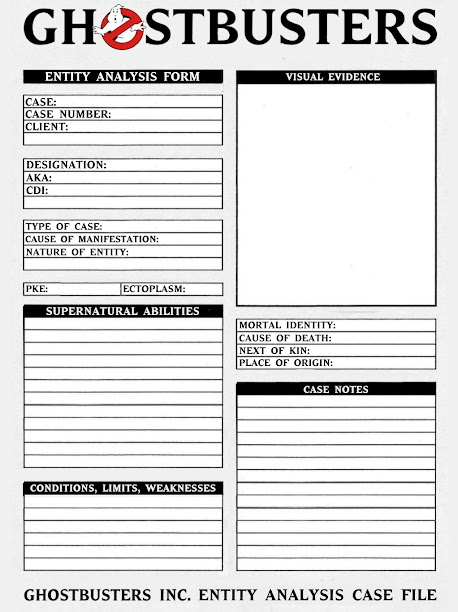
The same or similar Classes, the same or similar Intensities but VERY different capabilities. In fact, their write-ups would probably look something like this:


Next to each Supernatural Ability is the number of Action Dice rolled when that ability is used. 

In the case of offensive powers, a Success indicates a hit with additional Successes causing more damage. Terrifying Visage adds +1 Stress Dice to each PC (and living NPC) present per Success and an immediate Panic Roll is required. Adjudicate the results as previously described for a Panic Roll. The following round everyone goes back to their prior Stress Dice +1.

In the case of defensive powers, roll the Ability's Action Dice. Each Success adds +1 to the number of Successes a Ghostbusters needs to hit or trap the entity. Use the theme of the ghost and your imagination to explain why this occurs. For example, it is difficult to get a clear shot at The Missing Man through the driving wind and rain he summons. It is hard to get close enough to Captain Warms to drop a trap with his intense Flaming Aura. 

Some abilities have very specific effects that might not be directly damaging but cause problems nonetheless. Captain Warms Backdraft can not cause Bump Damage (explained further in my upcoming Combat post). It can hinder a Ghostbuster's Attributes or knock them backward. Successes after the first either send someone 10 feet back or cause 1 Die of Attribute Damage. 

Also, regarding Slime: All ghosts from Class III to VI can Slime people. Class II ghosts can leave Ectoplasm on rare occasions, usually with some effort. It is rare for Class VII's to Slime as their Ectoplasm is of a very different nature, consistency, and construction. Intensity wise, Mists to Masses are most likely to leave Ectoplasmic Residue, though on rare occasion a slime coated Corporeal/Undead can as well. 

What happens when you're Slimed? Stay tuned...

On the sheets I keep for my own records I have notes on various Supernatural Abilities and what they do, not to mention specifics for each entity. As a result, my version of the Librarian Ghost just says 'Terrifying Visage 5D' but lacks the explanation of how it works. That's for your benefit as I already know what I mean. 

OK, that's it for this one. Got the big Combat entry coming up as well as two other posts, one related to this project (kind of) and the other related to what I am gearing up for next year. 

See ya soon,

AD
Barking Alien