Showing posts with label Bushido. Show all posts

Wednesday, January 3, 2024

An Impurity In The Right Place Is A Quality

Have you watched Blue Eye Samurai? Yeah, I'm talking to you. You HAVEN'T? What are you even doing here?!? Go! Go watch it right now! Once you're finished you can join the rest of us at the Cool Kids table. 


Great, now everybody here has seen this series, we can discuss my favorite thing to come out in Pop Culture Media for all of 2023. That is not hyperbole. I'm 100% serious. Marvel, Star Wars, even Season 3 of Star Trek: Lower Decks and some great Anime I saw didn't come close to Blue Eye Samurai in my opinion. We're talking 11 out of 10, 6 Stars out of 5, 3 thumbs up, absolutely S Tier entertainment.

The art, animation, characters, plot, and direction were all top notch. Was it an absolutely perfect work? Perhaps not, it had minor imperfections here and there but overall I haven't seen any other series this past year that gets as close to ideal as this one. 

Enough praise, let's dig in...

Yeah, I know I insisted you see the show before proceeding but I'm feeling merciful.


As you know, I am not just an Otaku, I'm also a Nipponophile; I am interested in Japan's history, culture, food, and folklore. I've run Japanese 'Fantasy' RPG campaigns in the past but they are always set in the 'real' world of Shogunate* Japan with the addition of magic, spirits, and other elements of the mythology believed by the people of that period of history. I have no interest in Legend of the Five Rings' 'Rokugan' or D&D's 'Kara-Tur'. Much as I prefer Ars Magica's Mythic Europe to D&D's made-up places, I likewise prefer the Nippon of Bushido and Blue Eye Samurai to a fictitious world inspired by the real place and its people. 


With that as our starting point, let's take a look at the setting and themes of BES. They weren't all bright and shiny, sunshine and cherry blossoms. It was a look at a real place during a real time even if it followed a fictional story. Japan's Edo Period was a bloody, racist, sexist, and often terrible age for people who weren't the Shogun. Blue Eye Samurai doesn't shy away from any of this this. It instead embraces it as a key part of the composition of Edo Period Japan as the 'world' wherein this story occurs.

So the question is...is this the same world a Feudal Japan campaign takes place in? I would say a very definitive yes. For other players and GMs the answer might not be so clear or easy. I had some wonderful conversations a few weeks back with friends of mine who I game with regularly about whether they would include some or all of the negative elements mentioned above in their campaigns if they were setting a game in a historical setting.

My buddy Keith noted that one of his favorite periods in world history is The Age of Sail and a favorite game of his to run is Beat to Quarters, an RPG focused on playing members of the British Royal Navy in conflict with the French, Spanish, Pirates, and the intrigue of the court. One thing that was prevalent during this time that does not and will not appear is slavery. 


Keith has decided, based on how terrible and disdainful the American and European slave trade was, that it isn't something he wants in his Age of Sail games. No adventure scenario will feature it, it isn't something the PCs will be involved with, and it doesn't even get a mention. Why would it? That isn't what his games are about.

In my view, repulsive as it was and it was repulsive, it did happen. It is part of that time in history. I wouldn't dwell on it but I can't ignore it. Additionally, an RPG with the right GM, players, and tone might be the perfect place to discuss and explore these deeply regrettable and tragic aspects of the ongoing story of Humanity.

My love of Japan doesn't embrace its blemishes as positive things but neither does it pretend they don't exist. I accept the bad with the good and as a storyteller try to shed light on the darkness. This is what Blue Eye Samurai does as well and I would very much like to take cues from how well it handled these elements. 

Just some musings as I revisit the idea of running a Feudal Era Japan RPG campaign. Inspirations from BES definitely have me thinking about a rework of my Yokai Hunter Society concept.

More to come...

AD
Barking Alien


Thursday, June 30, 2016

BUSHIDO* - THE DESTINY OF SHINTO

My good friend, and Google Hangouts GM Keith Jacobson requested a Campaigns I Have Known entry on my most memorable Japanese mythology/folklore inspired Fantasy game. Funny thing is, one of the fellows in that game just recently posted a 'Remember This...?' entry on my wall on Facebook.

Well that's too much of a coincidence to ignore.

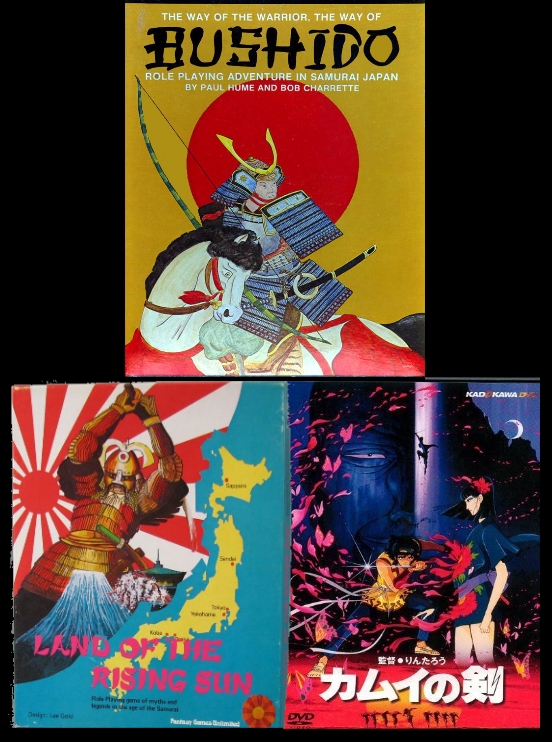
I've run a number of games set in a mythical, feudal Japan, but my preeminent one was Shinto No Unmei, or 'The Destiny of Shinto', back in 1988-89. I used Bushido, the Japanese Medieval Fantasy RPG classic by Fantasy Games Unlimited, although modified as noted below.

Campaigns I Have Known
Proudly Presents...

BUSHIDO
SHINTO NO UNMEI

The Mechanical and Creative Influences
for this campaign:

Bushido (FGU)
Land of the Rising Sun (FGU)
The Dagger of Kumi (One of my all time favorite animated films)


Title: BUSHIDO - SHINTO NO UNMEI

System: Bushido* (Fantasy Games Unlimited) - Additional Rules from Land of the Rising Sun (FGU), and House Rules.

*In truth, this campaign used a kitbashed system of my own making that was about 80% Bushido. The remaining 20% was a mixture of simplifying what was in the core rules, adding bits from Land of the Rising Sun (also from FGU), and a few house rules. The overall effect was, as I recall, very detailed while remaining highly functional.

 
Circa: 1988-1989. There were roughly a dozen sessions, each lasting 8-10 hours. For reasons related to scheduling conflicts we were never able to complete the climatic final battle and finish the campaign.

Sad panda.

Player Base: There were five players, all male, ages 18-20. All the players were present for all the sessions, and unlike a lot of my other games, there were no guest players, or characters.

Characters: I remember most of the characters from this game quite well, which in, and of itself is very interesting. Granted, this game was not as long ago as some of the others I've covered in the recent past, but I think it's more than that. This campaign was just that good.

Katsuhiko Otomo - Gakusho Shinto Priest / Shugenja (Played by Joe V.)

Katsuhiko Otomo was a Shinto Priest, or Gakusho, who initially hid the secret truth that his priesthood was a front for his real vocation - a Shugenja/Mage.

If I remember correctly, Katsuhiko was indeed trained as a Shinto Priest from the time he was a very young man. His ancestors came to him in a terrible dream, wherein they charged him with a quest to find a Ronin Samurai (Yoshi Yamashita) whose destiny would shape the future of Japan. Otomo was gifted/cursed with mystical powers to help him achieve this goal.

Katsuhiko was always the voice of calm, and good sense when the world around the PCs seemed to be spiraling into madness. At the same time, he was the most Human of the player characters in attitude, manner, and deed. He could be scared, get frustrated, and liked good food, drink, and a warm place to sleep when it was available.

Otomo avoided violence whenever possible, but could fight quite well with his Tetsubo (a knobbed bo staff/club), and various mystical powers, and spells.

Moki No Shingun - Neko Hengeyokai Kensai (Played by Eric F.)

Moki No Shingun (Moki of the March - Specifically 'Shingun' refers to a 'military march' or 'the coming of an army') was a strange young man with green eyes, and an oddly, eerily graceful way of moving. When first encountered, he was thought to be a commoner Bushi, a local warrior for hire. 'Moki' had developed a bit of regional renown, as he had defeated several bandit gangs with his enchanted sword, a very old tachi blade.

Like Nakagawa, and Otomo, Moki decided to join Yoshi Yamashita on his journey back home following the death of his uncle the Daimyo. It was implied that Moki may have had another reason for going as well. Something like, "I've been meaning to head that way. I would travel with you if you wouldn't mind the company."

Over time we learn that Moki No Shingun was a man of many secrets, including that fact that he was not really a man at all. Moki was a Hengeyokai, an animal spirit (in this case a cat) who could assume Human form. You could also become a seemingly normal cat, and with some effort and expenditure of Ki, a hybrid form with varying degrees of transformation**.

In addition to supernatural abilities from his status as a cat spirit such as amazing reflexes, balance, night vision, and stealth rivaling Nakagawa's, Moki was a Kensai, or 'Sword Saint'. His enchanted tachi was not enchanted at all. Rather, he spread that rumor to hide the fact that he had a number of Ki powers that could be channeled through his sword (or which needed a sword as a focus).

In one particularly awesome sequence, Moki and Shogu had taken a short cut through a forested area to come out behind an enemy. Yoshi and Katsu had taken the long way around the woods by traveling the main road. When Yoshi and Katsu arrived to enage the villain, they were surprised to have gotten there first.

It was taking an unusually long time for Moki and Shogu to get through the forest, which was peculiar since this was the short cut! Eventually, Moki used the Spirit Sight of his cat eyes to see that a curse had been placed on the forest. As they moved through it their speed bled away. Like a dream where you run, but go no where they were quite literally 'wasting time'.

Evoking the power of his Ki, and placing part of his spirit into his sword, Moki sliced through the curse, seemingly swinging at nothing, but in actuality 'cutting their time in half' (the player's description/explanation). Shogu and Moki then burst from the woods behind the enemy forces to see Yoshi and Katsu approaching from down the road.

Moki was an excellent swordsman, possessed of numerous special abilities as mentioned, and a decent hand-to-hand combatant. With not as proficient with martial arts as the other warriors in the group, he made up for it with remarkable speed, acrobatic skill, and the occasional claw attack.

Moki's full story is never completely revealed unfortunately. My idea, based on clues, suggestions, and other elements of the story was when the enemy forces summoned supernatural aid to assistance them with their plans, the Shinto gods sent Moki to level the playing field as it were.

Shogu Nakagawa - Profession Unknown - Definitely NOT a Ninja
(Played by Nelson M.)

Hailing from a small fishing village on the river, Nakagawa claimed to be the last survivor of a flood that had killed his family. Impressed with the wandering Ronin Yoshi Yamashita (and he with Shogu), the two quickly became allies if not friends (not right away anyway). Nakagawa decided to tag along with Yamashita on his journey to avenge his uncle, the former Daimyo.

Shogu had an interesting skill set that made him at once very useful, and at the same time difficult to categorize by way of profession, and station in the setting's society. At first he seemed to be a beggar from a fishing village that had fallen on tragedy. He could fight  very well unarmed using martial arts, or with a sword like a Bushi (a Warrior, or Soldier). He was quick, stealthy, knowledgeable about the woods, and knew various pyrotechnic tricks that lead some to believe he was a Shugenja.

Eventually, the group determined Nakagawa was an entertainer; an actor or performer of some kind trying to make a living off his skills. One thing was certain of course - since Ninjas were fictitious bogeymen long gone from the world, Shogu was definitely NOT a Ninja (an ongoing, in game line said as a running gag by one player, or another at least once every session).

The truth of course was that Shogu Nakagawa was very much a Ninja. He was the last surviving member of the Dark River Ninja Clan. A mysterious patron had hired the Dark River Ninjas to defend the Daimyo against an attack that was known to be taking place later that evening. The Dark River Clan, the Daimyo, and all his bodyguards, and forces present were killed in the attack.

It is unknown if the patron was honestly sending the Dark River Clan to help the Daimyo, but they were overpowered, or if it was all an ambush set up by the mystery employer.

Nakagawa primary weapon was a Tanto (Japanese samurai short bladed sword, or long knife). He would later use a Ninjato / Tanto combination, oddly mirroring Yamashita's occasional use of the traditional samurai pairing of the Katana and Wakizashi.

Nakagawa used a mixed martial arts style that was part Kung-Fu, part Jujitsu, and part Karate. He perfected the 'Flying Dragon Kick' - a devastating, Ki-enhanced, running leap kick.

Yoshiyuki Yamashita - Ronin Samurai (Played by David C.)

Youngest male of the Yamashita Clan, nephew of the great Daimyo Masao Yamashita. Yoshi was off delivering a message to Yamashita Clan allies when his uncle's fortress-like home was attacked and invaded. Word reached him while he was passing through a small town on his way back.

With his uncle dead and his father having passed on when he was a young boy, Yoshiyuki was now technically Daimyo of the region. Since he was not present when the Daimyo and his fortress fell, those familiar with his clan colors and emblem but who did not recognize his face assumed he was Ronin - a masterless samurai at best and at worst a coward.

For a short while he hid his identity and excepted the Ronin label to avoid the culprits of the attack targeting him before he could get to the bottom of what had transpired. Surviving brigands and assassins on his way back home, Yoshi befriended a wandering priest (Katsuhiko Otomo), a vagrant performer (Shogu Nakagawa), and a peasant bushi (Moki) who all decided to join him on his journey.

Evidence at the site of what could only be described as a massacre seemed to point toward foreign invaders, but the clever Yoshi, with the help of his new friends, soon realized this was a ruse.

Whomever the attackers were that slew his family, his clan-mates, and sent the region into chaos, they were not Buddhists, Chinese, or anything of the sort. They were Japanese, cleverly but cruelly trying to frame foreigners. In addition they had brought with them a supernatural element. They were evil, pure and simple, and they needed to be vanquished.

While skilled with the paired Katana and Wakizashi combo traditionally attributed to samurai, Yoshi more commonly utilized an Odachi, a long or 'great' sword that predated the Katana. This was especially true after he found the enchanted Odachi dubbed 'Ashita' (Japanese for Tomorrow).

Yoshi was also adept at martial arts, focusing on karate, judo, and an early form of aikido. He created his own close quarters fighting style patterned after Chinese Kung-Fu which he dubbed Mongoose style. It primarily consisted of very quick, short punches that started low on the opponent's body and then moved upwards towards the neck, face, and head.

Synopsis: I'm sure you can piece together a good bit of the campaign from the character write-ups, but to consolidate and simplify...

While on a mission to deliver a treaty agreement to his clan's potential new allies, Yoshi Yamashita, youngest adult male of the Yamashita clan, discovers that his uncle Masao, the regional Daimyo, was killed along with most of his family, loyal retainers, and samurai.

Yoshi immediately vows to return home, only to discover rumors have been spread explaining his absence at the battle that destroyed the Yamashita Clan as cowardice.

Travelling in disguise as a Ronin, Yoshi crosses paths with a wandering Shinto Priest named Katsuhiko Otomo, a strange Bushi called Moki No Shingun, and a beggar and performer named Shogu Nakagawa. Together they journey to the fortress home of Yoshi's uncle, which begins an intricate mystery as to who attacked and why.

Without the Daimyo's influence, the area quickly erupted into chaos, with numerous enemies and allies alike attempting to take control of the countryside. Only the Ikeda Clan, old and wise, stayed out of the competition - ready to assist whomever came out on top with the transition form the old order of the day to whatever new status quo resulted. Eventually clues and later hard evidence pointed to the Ikeda clan as the instigators and orchestrators of the entire predicament. Also, it seemed they had a supernatural ally, a Witch who may have been possessed by a Demon, or perhaps been a Demon herself.

With the help of his allies and the pure nature of his heart, Yoshi Yamashita showed his true identity as a man of loyalty, honor, and leadership. He assembled a volunteer army of mercenaries, commoners, and peasants and lead them against the Ikeda clan, and it's allies.

The final battle between Yoshi and the leader of the Ikeda clan, as well Moki and Katsuhiko versus the Demon-Witch, and Shogu of the Dark River Ninjas against the leader of the Fire Mountain Ninjas was, sadly, never run. It is one of my deepest, hell one of my only, gaming regrets.

***

In addition to the Action/Adventure Cinema nature of this campaign, it was also one of my first to go a little deeper and tackle social, political, cultural, and even religious ideals and issues. While there is definitely a focus on the hero's journey here, The Destiny of Shinto was also about more than that.

A lot of the game had a sub-context that asked, "What happens when a society and culture changes - whether from within or without due to outside influences?"

Are we better off changing and adapting with the times or do we fight for our established traditions and beliefs?

Although set at an indeterminate period in Japan's history, it is definitely a time one can roughly estimate with careful observation. Japan is aware of China in the campaign and the threat of 'foreign invaders' (as well as being the foreign invader) is very real. Buddhism is depicted as encroaching on the old ways of Japan's Shinto culture and religion. It is initially framed as foreign, different, and perhaps dangerous but eventually it is clear it isn't 'evil'. It is simply a different set of beliefs.

The death of Masao Yamashita and the 'old' Yamashita clan must be avenged by Yoshi, who seeks to carry on the memory and traditions of his ancestors. At the same time, Yoshi adapts to the changing times better than his predecessors. He does things his way. He doesn't lose who he is or where he came from, but he doesn't dwell in the past either.

Appendix N: The source material found in Bushido and Land of the Rising Sun was actually some of the best, most accurate material on Medieval/Feudal Era Japan ever produced for RPGs. Lee Gold, who wrote much of Land of the Rising Sun, would later go on to do GURPS Japan, another fantastic resource.

In addition to the games themselves I found information and inspiration in several books on Japanese culture, mythology, folklore, and religion in a number of libraries and Japanese bookstores (only one of which remains in New York City - Kinokuniya Books. Sadly Asahiya Books and Zen Oriental Bookstore are both closed).

Additional resources included Osprey Books, Akira Kurosawa films, and numerous Japanese Anime/Manga, especially The Dagger of Kamui, a huge favorite of mine. It really set the tone for much of the game.

Finally, I had two very special consultants on the campaign. One was a young Japanese woman I was friends with who was born in Yokohama (I believe). She only lived in New York during the school year, then returned to Japan in the Summer. I think her father was a diplomat, or something. The second was a friend of mine who was half-Japanese. He was an aficionado of Samurai era Japan.

Bonus Features:

I wanted to use as much, and as accurate, Japanese naming as I could (which wasn't easy in the days before the internet) but my 'consultants' really helped in that regard. That's true for any of the Japanese words we used, from meaning to pronunciation.

Dave and Nelson had been in a few games together.
Dave and Eric had been in a number of games together.
Eric and Nelson had been in games together.
Joe had been in games with Dave.

This was the first campaign I can recall where all four of them were PCs in the same game at the same time.

I didn't own a copy of Bushido at the time, nor Land of the Rising Sun. I borrowed a friend's copies in order to develop the campaign.

The phrase, "He's NOT a Ninja", in regard to Nelson's character Shogu, began honestly and naturally. The other PCs really didn't think he was playing a Ninja, but couldn't figure out what his profession was. When it became clear he was indeed a Ninja, we established in game that Yoshi had convinced himself of the delusion that his good friend could not possibly be one of those terrible, not to mention mythical, assassins.

Anytime some plays a Ninja or Ninja-like character in any games, of any genre, and part of the conceit is that they are hiding that fact, the phrase "He's NOT a Ninja" is uttered by someone in the group in the exact same way we said it back in 1988-89.

**Moki No Shingun could change himself into a 'Catman', though more often he only changed a part of his body. He was more likely to be a man with cat eyes, clawed fingers, padded feet, or have Anime style cat ears. I only recall once or twice where he did a full, hybrid transformation.

I apologize for the lateness of this post.

Originally done on June 28th, and edited on the 30th, I meant to post it that Thursday due fell asleep. I've not been sleeping well again recently - more so than usual I mean - and it's thrown off my posting plans. Hopefully this was entertaining enough to be worth the wait.


ありがとう楽しい時過しなさい

AD
Barking Alien


Wednesday, September 3, 2014

Dark Clouds At Land's End - Part I

As of now, September has no particular theme. My only goal is to produce more posts this month than my 12 post a month average for this year so far.

I do have things to talk about, so I'm ahead of the game.

(The game! You see what I did there? Wokka Wokka!).

I'd like to start with this post-Labor Day post-game post; I present to you a series of our writes ups, recaps, and overviews of the first, full session of our new Bushido campaign, Dark Clouds At Land's End. I will also run down the PCs, major NPCs and supernatural beings we've encountered (Thus far. More of all of these participants will be joining us soon). I will also review and 'prologue session', which was run a week ago after creating characters together.

Let's begin with...

Part I - The Cast of Player Characters


Mori Clan Mon (Crest)
 

Fujikawa Yoshi  (Ray)

A travelling storyteller, or Kataribe, Fujikawa goes to city to city, town to town, bringing news from neighboring lands, and pick up new information from the locals in exchange. He is well versed in both history and rumor, and for a commoner, he is extremely well spoken, apparently educated, and seemingly quite cowardly at times. While that last trait does not endear him to the local Samurai, the knowledge he has, and the knowledge he obtains, has proved invaluable.

(Barkley's Fun Fact #1: In our Traveller campaign, Operation: Paladin, Ray plays Dr. Emil Fujikawa).


Kitajima Kai  (Andy)

A Buddhist Priest, this Gakusho has arrived in the Izumo Province after a long journey from the far North East. He is on a personal pilgrimage, and intends on visiting the many shrines and temples in the region (many even for Japan!). His Northern origins go some way towards explaining the Buddhist teachings he has learned, yet his family name is more common in the surrounding region of Izumo, Tottori and Okayama. In addition, he has a family name! Though describing himself as a simple monk and a Heimin man, he bares the air of more noble station. A Priest who formerly served a Samurai family or Daimyo perhaps? Unknown at this time.


Miyamoto Kiwa  (Hans)

The peculiar young woman known as Miyamoto Kiwa is a Miko, or 'Shrine Maiden', at the shrine to Izanami-no-Mikoto, Shinto goddess of both creation and death. The Izanami Shrine is one of the towns' three largest, and tied to a temple that was built along with the very foundations of Tochitokumo.

Kiwa-chan is very serious and straightforward. For a priestess, she can sometimes seem to be stoic, even unsympathetic. She tries, but her voice and manners belie the fact that she doesn't really connect with others the way normal people do.

She has been asked by the Magistrate of the town, and her superiors at the temple, to perform a ritual on the eve of the new moon each month for the home of Mori Taheshi. It would appear that Taheshi-sama's house is haunted by an evil spirit.

(Barkley Fun Fact #2: In our Traveller campaign, Hans plays Amaya Takeda, also a Japanese woman.)

(Barkley Fun Fact #3: Hans almost always plays female characters)

There was a clever, out-of-character comment made when Fujikawa and Miyamoto met.

Fujikawa: "It's a pleasure to meet you. Perhaps in 4000 years or so, our descendants will travel through space together."

Miyamoto: *Stunned a moment.* "That'd be lovely."


Mori Taheshi  (Will)

Our resident Samurai warrior, a Nobleman Bushi, and the only one of the groups number to be of rank and privilege (such as it is in this poor town). Taheshi-sama is a very serious young man with a lot on his plate. In addition to his duties as town 'sheriff', Mori is raising his 3 year old daughter, with the help of his sister-in-law. Mori married a commoner, much to the dismay of his family, and while a very strong woman physically, mentally and spiritually, she died in childbirth.

Exactly one month after the child was born, an evil spirit, some form of yokai, began to haunt the Mori household. Thanks to priests of Izanami, and eventually Shrine Maiden Miyamoto Kiwa, a blessing was placed on the home which protected those within. This did not stop the spirit from making moaning noises, whispering, or scratching at doors.

Mori Taheshi blames himself for this incident, but his reasoning is rather, odd. He believes he and his family are being punished for his turning away from the Samurai ways and marrying a Commoner woman. Also, it is possible the patron kami of his wife's family, a minor kami of the forge, and metalsmiths, is enacting revenge for taking the wife away from his relatives.


Shiro (Steve)

A young man of only 16 years of age, Shiro lives in a hovel in the woods with his old master, a wise man and soothsayer who has lived in or near the town for as long as anyone can remember. Rumor has it the man is a Shugenja sorcerer, but few actually believe this.

Shiro, as it turns of, is not just a 'wizard's apprentice', he is also not entirely Human. Fine, he isn't Human at all, expect periodically, when he feels like. Shiro is a Fox Hengeyokai. Quite different from the often mischievous and troublesome Kitsune spirit, Fox Henge are usually either helpful towards Humans, or largely try to ignore them.

Actually a Fox by nature that can become a Human, Shiro has proven a good natured opportunist. He is willing to do his part to help this curious group of people who, as it currently stands, are an excellent source of clean lodging, free food, and a chance to impress his Sensei, the wise man of the woods. OK, hermit. He's a hermit.

As of now, Shiro's specialty is magic in the Elemental School of Water.

***

The plan is for at least one additional PC to join the group. The often-mentioned Dave will be joining us with a Budoka, a wandering martial artist who wanders no longer. Now a simple fisherman, he seeks enlightenment and a path to his destiny in the small village where his mother was raised.

More on him another time...

I have so much to talk about this month.

AD
Barking Alien


Monday, August 25, 2014

RPGaDay Challenge - Day 24

Day 24 - Most Complicated RPG Owned


I own a surprising number of complicated RPGs.


Surprising because, as any regular here on Barking Alien can tell you, I don't much like complicated RPGs. In most instances, I despise them.

It is therefore among the universe's great, unexplained paradoxes that I should be a fan of Champions, Bushido, and, yes, Space Opera. It's right up there with why we call it a 'bus stop' when it should be a 'bus pause'. I mean, the bus starts up again like a minute later...*

Space Opera aside (I will address that particular enigma below), I guess what it boils down to with these first two games, is that they just work for me. They do what I need them to do. These games facilitate a certain style of play in a particular fashion that I enjoy enough to put up with the crunchiness and relative complexity.

With Space Opera, who the heck knows. I'm not even sure how we played that game, but we did, and quite a lot at one time. I am pretty sure that much like Bushido, we house-ruled it in order to wrangle it into something resembling coherence.

OK, that's not far. Bushido doesn't need that much house-ruling. Space Opera needs a crud-load.


AD
Barking Alien


*Special thanks to the late, great George Carlin for that one.


Wednesday, August 20, 2014

Thunder, From A Clear Blue Sky


夏の終わりに
我々 が探していたゲーム
私たちを発見
 
At the end of summer,
the game we were looking for,
found us.


The Barking Alien gaming group's next campaign (attempt) will be...


Outside of our very successful Traveller campaign, other campaign attempts with my current group have generally fallen a tad short of awesome. When I say a tad, I am actually referring to something roughly the size of the Marianas Trench.
 
One thing I have been hankering to do for a while is a Fantasy game, although since I dislike traditional Western Fantasy so much, I kept trying to introduce some variant that got back to what I do like, the origin sources of Fantasy, namely European folklore and myth.
 
Unfortunately, the ideas I had for this approach, such Pendragon and Ars Magica, were sort of dependent on everyone at least having a general familiarity with the folklore and fairy tales the material was based on. This was sadly not going to happen. In addition, players in my group seemed instinctively against playing to the setting for some reason (especially in Pendragon).
 
While pondering this campaign conundrum yet again, I went about asking some friends and acquaintances what non-D&D/Pathfinder games they'd run across that they could recommend. Most suggested 13th Age, Dragon Age, The One Ring, and of course Ars Magica and Pendragon, which I had already ruled out trying again so soon.
 
One fellow suggested Chivalry & Sorcery, and while I knew that wasn't my thing, I did a search on it, and came across Land of the Rising Sun, the Lee Gold variant of C&S set in Fantasy Feudal Japan that I had actually played a bit as a kid. I liked it enough, but not as much as...
 
THUNDERSTRIKE OF INSPIRATION! Gaming Epiphany Moment!
 
My players love Japanese culture (actually, two of them are half-Japanese by coincidence), history, Anime/Manga, and mythology. I am a huge fan of Japanese folklore and ghost stories, not to mention being a Kurosawa film buff. A Japanese Medieval Fantasy game? Perfect fit!


 Samurai illustrations for Osprey Books
by the incomparable Angus McBride
 
  
Now, no well planned engagement survives contact with the enemy, and I've come to learn no great campaign idea survives contact with my players (sigh), but this is definitely more promising than not.
 
I have high hopes. Wish us luck, and I will keep you posted.
 
Since I'm on the subject...
 
Bushido: Games I Like By Age of Ravens
Retrospective: Bushido By Grognardia
Asao Iwakuro, Shugenja By Dyson's Dodecahedron


Arigato Gozaimasu,
 
AD
Barking Alien